
Our audits turn crawl chaos into road maps with clear indexation, architecture, performance, and schema owners, timelines, and projected ROI.
Why Your SEO Efforts Are Stalling
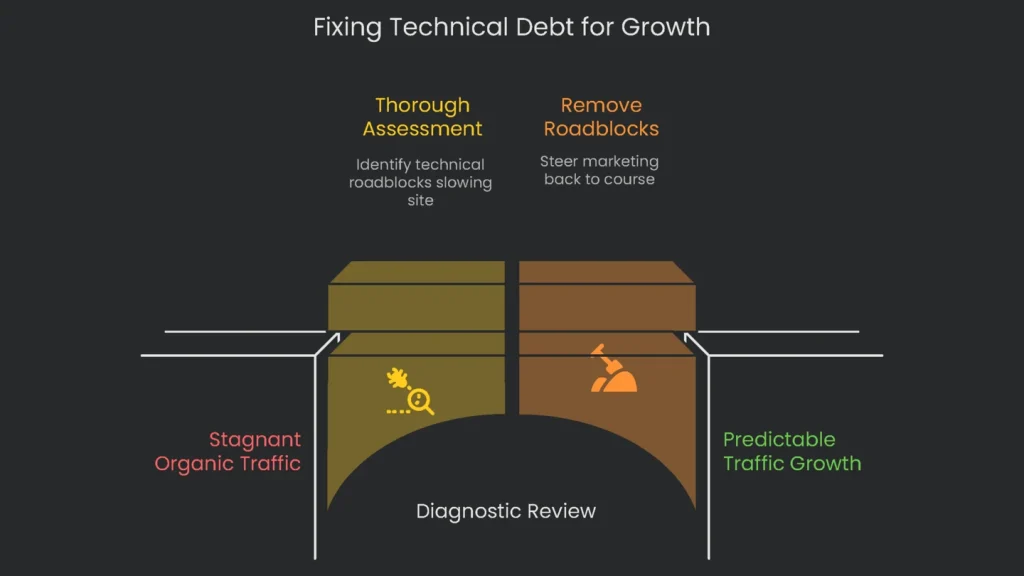
The Hidden Technical Debt
Money, effort, and time are all tied into your site. You write killer posts, get backlinks, and launch campaigns, yet results stay frozen. Consequently, organic traffic sits still or, worse, starts to drop. Meanwhile, the competition inches ahead and you’re still scratching your head. In short, the marketing plan often isn’t the problem. Instead, the culprit sits in the shadows—technical health issues buried in your code that jeopardize every promotional move you make.
Your Site’s Structure Is the Foundation
Your website acts like the unseen skeleton holding everything upright. It determines whether search engines, especially Google, can crawl, read, and trust the content you publish. Without a solid structure, even the most brilliant content strategy falls flat. Undetected, these issues become stealth roadblocks, draining your budget and the budget’s promise for a return. Therefore, it’s the same as planting a lavish storefront in the sand.
First Step: A Diagnostic Review
A thorough diagnostic review is a must. It’s the vital move that sets the stage for search-friendly, high-performing results. It’s more than a routine inspection; it’s a careful assessment that supplies vital numbers for smart decisions. By spotting and removing the technical roadblocks that slow your site, you steer marketing back to a steady, predictable course. As a result, this transforms your site from a headache into a valuable power plant for lasting, free traffic growth.
More Than a Checklist: A Deep Dive
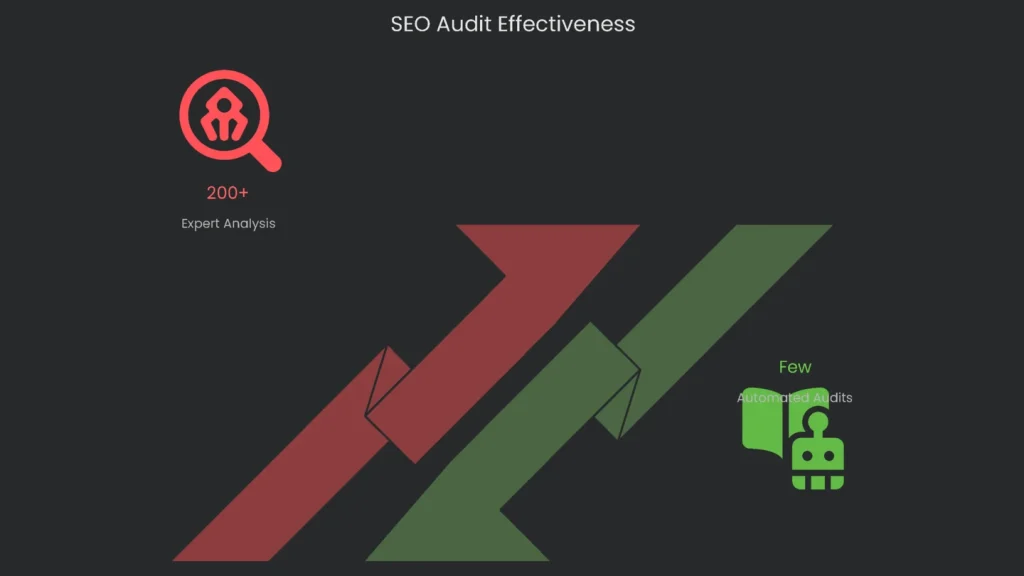
Automated Audits vs. Expert Analysis
You’ve likely come across free or dirt-cheap “SEO audit” tools. These automated scanners generate long reports filled with percentages and mystery terms in seconds. However, while they flag obvious red lights, they leave you with more questions than answers. What’s missing are the context, the seasoned insights, and the priorities that matter most to your site. A self-generated report is like a thermometer alerting you to fever. It proves something’s wrong, but it doesn’t trace the germ or the remedy.
Our Approach: Tools + Humans
It also misses the vital thread of your business goals, your competitors’ moves, and the tangled technical quirks that truly hold your site back. Acting on unfiltered figures can waste developer time as they polish small stains while bigger, damaging issues fester. Our In-Depth Technical SEO Audit goes beyond the ordinary. We blend powerful analysis tools with sharp-eyed human expertise. Instead of a generic checklist, every website is treated as a custom project.
Turning Findings Into Business Outcomes
We dig deep into technical architecture, hunting down the precise roadblocks that slow ranking. The review scans more than 200 technical signals, so nothing slips through the cracks. The true benefit comes from how we turn technical noise into a straightforward business case. Therefore, we show not only what needs fixing, but why fixing it helps the bottom line. We highlight minor issues, flag major roadblocks, and list quick wins that can start showing clicks within weeks. Instead of a confusing spreadsheet, you receive a readable, actionable prioritized plan that directs your next SEO moves.
What Our Audit Uncovers
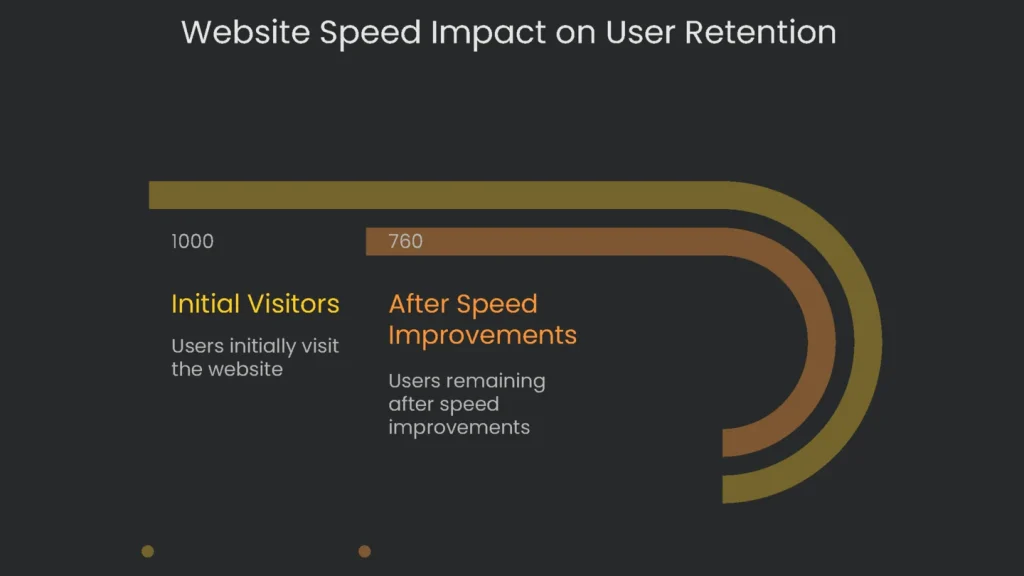
How We Structure the Findings
A site runs well only when its technical gears mesh perfectly. Our audit acts like a mechanical blueprint, examining every core system and identifying the weak links. For each, we not only flag the flaw but also recommend the simplest fix that keeps the machine humming. Through this lens, the audit feels less like a report and more like a smooth upgrade plan.
Three Business Goals Behind Every Fix
We break down tech problems so they make sense. Each problem ties back to three big goals: getting more people to see you online, winning their trust, and boosting your revenue. Consequently, every recommendation supports measurable growth.
| Technical Component | What It Is | Why It Matters for Your Business |
| Crawlability & Indexability | Can search engines find, access, and store your web pages in their database? | If search engines can’t index your pages, your site stays invisible to the customers you’re trying to reach. |
| Site Architecture & Internal Linking | Is your website logically structured to guide users and distribute ranking authority? | A clear structure leads to more conversions, directs authority to important pages, and emphasizes your expertise. |
| Website Speed & Core Web Vitals | Does your site provide a fast, smooth user experience on all devices? | A swift, stable experience delights users, reduces bounce rates, and boosts sales and rankings. |
| Mobile-First Optimization | Is your site easy to use for the majority of visitors on smartphones and tablets? | A subpar mobile experience sends visitors away and drags down your search ranks. |
| Duplicate Content Analysis | Are your identical or very similar pages splitting your SEO earnings? | Consolidating duplicates strengthens your ranking signals and avoids confusing search engines. |
| Structured Data & Schema | Are you helping search engines understand your content for enhanced search results? | Doing so can produce eye-catching “rich results” (like star ratings) that boost clicks and traffic. |
| Website Security (HTTPS) | Is your site secure and trustworthy for users and their data? | A secure site builds user trust, protects customer data, and is a proven ranking element mentioned by Google. |
A. Crawlability and Indexability
Definition: Crawlability refers to how a search engine moves through and follows links on a site. Indexability is the search engine’s capacity to analyze content and keep it inside its vast collection known as the index. You could picture the crawler as an adventurous scout surveying a territory, while the index acts like a museum cabinet that decides which artifacts to display.
Business Impact: This is the foundational step in search engine optimization. Without crawler access, search engines cannot add your pages to the index. When a page is absent from the index, it is invisible in search and cannot generate organic clicks, regardless of content quality. Many sites accidentally block search engines through costly mistakes. When we scan a site, we look for these blockers: a rogue robots.txt file that says “no entry,” a stray noindex tag that keeps content private, broken links that create dead ends, and poor crawl budget that prevents prioritizing critical pages.
Therefore, making sure your site is easy to crawl and index is the first step to being seen online.
B. Site Architecture & Internal Linking
What It Is: Site architecture and internal linking is the blueprint of your website. It shows how pages are organized into categories and how they connect. Internal linking is the web of links joining these pages, guiding both visitors and search engines.
Why It Matters for Your Business: Good site architecture does more than tidy up your site; it boosts both SEO and sales. A clear structure helps visitors find what they want and makes them more likely to buy. From an SEO angle, internal links share authority. When a respected page links to another, it boosts that page’s visibility. For example, Google uses this architecture to gauge how knowledgeable you are. By arranging related topics around a central pillar page, you show authority on that subject, which can help your site rank for related searches.
However, a jumbled website structure can leave key product or service pages “orphaned,” making them tough to find. Both users and search engines end up missing them.
C. Website Speed & Core Web Vitals
What It Is: Core Web Vitals are key metrics from Google that measure how users really experience a webpage. These metrics focus on three areas: how quickly the main content loads (Largest Contentful Paint or LCP), how quickly the page responds to clicks (Interaction to Next Paint or INP), and how stable the layout is as things load (Cumulative Layout Shift, or CLS). You can dive deeper on the official page.
Why It Matters for Your Business: Speed is no longer a minor tech issue; it drives big outcomes. Google states that page experience—measured by Core Web Vitals—counts as a ranking factor. Moreover, a slow or jumpy website annoys visitors and nudges them to competitors. Google’s research shows that hitting the right CWV levels can lower page-abandonment rates by 24%. Therefore, if you want customers to stay, your page needs to be fast and stable.
Major brands have seen real ROI from fixing these metrics. For example, a dashboard that loads text and images instantly or a product page that avoids layout shifts can lift conversions and reduce bounce rates.
- Vodafone boosted its Largest Contentful Paint (LCP) by 31%, which led to an 8% increase in sales and a 15% hike in its lead-to-visit ratio.
- Swappie, a mobile e-commerce platform, improved its Core Web Vitals and saw a 42% jump in mobile revenue.
- Carpe optimized its largest content and layout stability, gaining a 5% increase in conversion and a 15% boost in total revenue.
Our thorough audit analyzes every metric of your site’s performance, spotlighting the exact roadblocks—like oversized images, unoptimized code, and sluggish server responses—that drag your Core Web Vitals and scare off shoppers.
D. Mobile-First Optimization
What It Is: Mobile-first optimization revolutionizes your web design to give smartphone and tablet users an edge-to-edge, lightning-fast, and fully clickable experience. It is not enough to resize the layout; text must be legible, buttons tap-friendly, and menus swipe-friendly for anyone using a fingertip as the cursor.
Why It Matters for Your Business: Today, mobile devices deliver the majority of web traffic. Since search engines adopted “mobile-first indexing,” they focus on the phone version of your page to decide how your site should rank. Your desktop site doesn’t get a pass by default. An unoptimized mobile experience doesn’t just irritate a small segment; it reduces your visibility across all devices. Consequently, users bounce, engagement drops, carts are abandoned, and pages get demoted. In response, we conduct an exhaustive mobile usability check that evaluates how quickly your pages load, how smoothly they navigate, and how well the design works on a small screen.
E. Duplicate Content Analysis
What It Is: Duplicate content checks examine identical text on multiple URLs, which can be hosted on the same site (internal) or on a different domain (external). Often, the problem appears by accident through technical factors. For instance, a site can be opened with various versions of the URL: with http, with https, with the www prefix, or without it. When the same piece of content sits on multiple pages, search engines must choose a version, wasting crawl budget and risking Content A ranking lower than B for generic reasons. Therefore, checking and resolving every one of those copies remains vital.
Why It Matters for Your Business: When search engines stumble upon several copies of the same content, they can get lost. They must hand-pick which one is the “original” or the most relevant to display. This uncertainty dilutes ranking signals; instead of funneling authority and backlinks to one page, power divides across several URLs. As a result, each one may rank lower. A search engine might also show a version you’d rather hide, like a link with tracking parameters. This can skew analytics. Our audit uncovers duplicate content and advises the right technical fixes—be it canonical tags or 301 redirects—to pool signals and ensure the right pages climb the results. Finally, we recommend regular checks so issues don’t resurface.
F. Structured Data & Schema Markup
What It Is: Structured data is a standard code vocabulary, usually from Schema.org, that you add to your website’s HTML. Adding this code helps search engines better understand the context and specifics of your page content. It functions as a digital translator that tells search engines, “This is the author, this is the product price, and this is the event start date.”
What Structured Data Really Does: This extra code floats in the background, invisible to your visitors, but to search engines it clarifies intent. For example, it can say, “This item is a product, and its current price is $29.99, with a 4.5-star average.” Or it labels each question and answer on your FAQ page so visitors can see expanded links right in search results.
Why It Matters for Your Business: The biggest perk is eligibility for rich results. These interactive listings can show star ratings, prices, event times, or accordion-style FAQs. Because they stand out, they draw the eye and clicks without any change in your ranking. Since the listing shows more about your content, visitors arrive already interested and are more likely to stay. It’s free extra visibility that turns browsers into visitors.
Business Impact: The results speak for themselves:
- Nestlé: The brand saw an 82% jump in click-through rate for rich result pages compared to the standard blue link version.
- Rotten Tomatoes noticed a 25% lift in click-through rate on any page that used structured data.
- Rakuten reported that shoppers stayed 1.5 times longer on pages featuring structured data.
Our audit will show you exactly where to add structured data across your site—from product listings and service pages to blog posts and local business info. We even hand you ready-to-use code so you can capture attention fast.
G. Secure Your Website (HTTPS)
What It Is: HTTPS means your site communicates securely by using an SSL (Secure Sockets Layer) certificate. The certificate encrypts any data passed between a user’s browser and your server.
Why It Matters for Your Business: In a data-first world, a secure connection is more than recommended; it’s expected. The padlock icon and “HTTPS” in the address bar serve as a first signal of trust. Customers, whether they’re filling out a contact form or completing a purchase, need to know their information is safe. Without SSL, Chrome and other browsers display a “Not Secure” alert, which can send your site’s traffic—and reputation—down the drain.
That red Chrome “Not Secure” warning can wipe out trust in a split second, leaving shoppers or leads ready to click away, especially on e-commerce or lead-gen pages. Besides these risks, Google has publicly confirmed that moving to HTTPS provides a small SEO lift. Our regular site check verifies that your SSL certificate works perfectly, every resource loads over HTTPS, and all visitors are forced onto the secure site. Consequently, you lock in trust and encrypt every customer interaction.
From Audit to Action: Your Roadmap
The closing report is where too many SEO audits fail. Teams receive a sprawl of dense pages, packed with buzzwords and a daunting laundry list of “fix this or else.” That doesn’t guide anyone; it simply adds to the to-do list.
That’s why we end our checks with a straightforward delivery: the Actionable Roadmap to Organic Growth. This is a tactical outline, not a bug list. It highlights the moves that drive the strongest gains per dev hour and marketing dollar spent. Every page, list, and figure is colored to show clear priorities; the team can start executing the moment they hit “download.”
Our roadmap is guided by three key principles:
- Focus On People: Any updates have to genuinely help the students and teachers using this platform every day.
- Learn and Improve: Each part of the plan is a chance to gather feedback, test ideas, and make them better.
- Keep It Simple: All changes need to feel easy and clear—students shouldn’t have to struggle to use a new tool.
Implementation steps
- Launch a diagnostic crawl. Grab intel on crawlability, architecture, speed, schema, and backlinks.
- Rank findings—impact times effort times risk—then lay out a game plan.
- Brief dev and content teams with crystal-clear tickets and what “done” looks like.
- Back up code and content; run QA on dev, stage, and prod.
- Report results with before-and-after numbers, then stack up next moves
Frequently Asked Questions
What is included in your site check-up?
We check how pages are crawled, how the site is set up, how quickly it loads, how markup is used, whether it’s secure, and plenty more.
What do I get once the check-up is done?
A list of tasks ranked by how much effort they need, with clear assignments and deadlines.
How long will it take?
It depends on how big and complicated your site is.
What systems do I need to give you access to?
Google Search Console, analytics, content management system, and sometimes access to server log files or your hosting panel.
Do you do the fixes for me?
Yes—we offer advice and can work side-by-side with your team or take the lead ourselves.