We fix foundational issues, amplifying content and links, from crawlability to Core Web Vitals which eliminates stalling organic growth.
The Case for Technical SEO as a Growth Engine
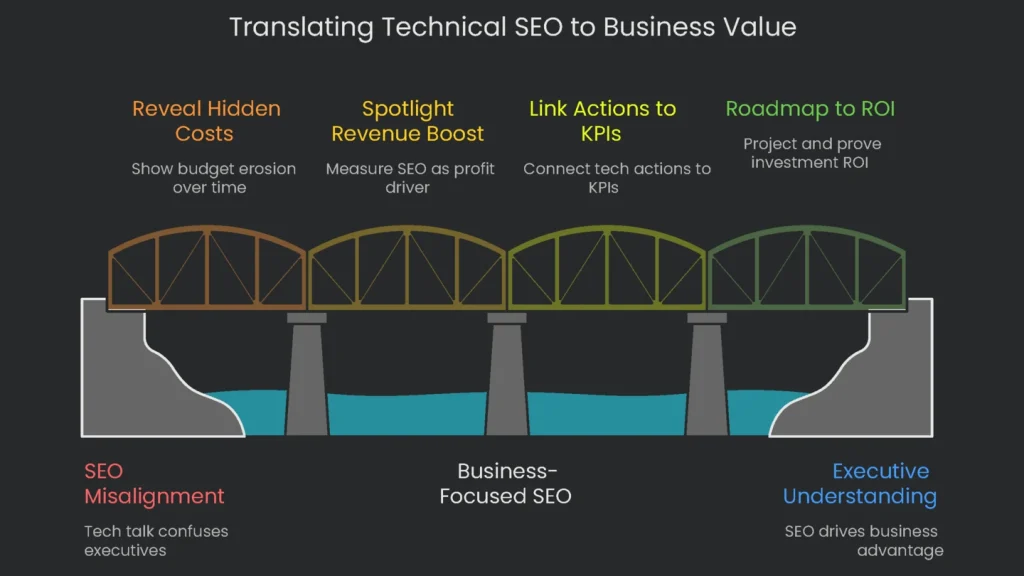
Speak in Financial Outcomes
Talk CFO, not HTML. In-house marketers often hit a wall with technical Search Engine Optimization (SEO) when they enter the corner office. The meeting drifts from eye-popping organic traffic forecasts to “What’s the payback period?”. However, technical SEO often feels murky, packed with buzzwords that translate to “I don’t touch this, approve that” for the people holding the wallet. Terms like “schema,” “robots.txt,” and “server-side rendering” sit like furniture nobody can sit on-interesting, yes, but seemingly irrelevant to revenue, exposure, and risk.
Fix the Translation Gap
The misalignment isn’t about SEO’s worth. Instead, it’s about translation. This article fixes that translation. It speaks technical SEO in a dialect the C-suite understands-business advantage, not bits and bytes.
Compounding Returns From a Solid Foundation
Think of a well-tuned technical SEO strategy as your revenue amplifier. When the underlying architecture of your website is solid, every dollar you invest in content, paid clicks, social media, or sponsorship travels farther. Consequently, it rings clearer and earns compound returns. The foundation is silent, but it lifts the whole structure higher.
What This Report Covers
This report gives marketing leaders a straightforward plan backed by numbers. First, we reveal the hidden price of sitting still, showing that a shaky tech base quietly gobbles up budget month after month. Next, we spotlight measuring tech SEO as a revenue booster that sends profit through every other marketing channel. Then we link specific tech actions directly to the Key Performance Indicators (KPIs) the C-suite tracks. Finally, we wrap up with a simple roadmap to project and prove ROI, so you can confidently ask for the investment you need.
The Silent Salt of Technical Debt
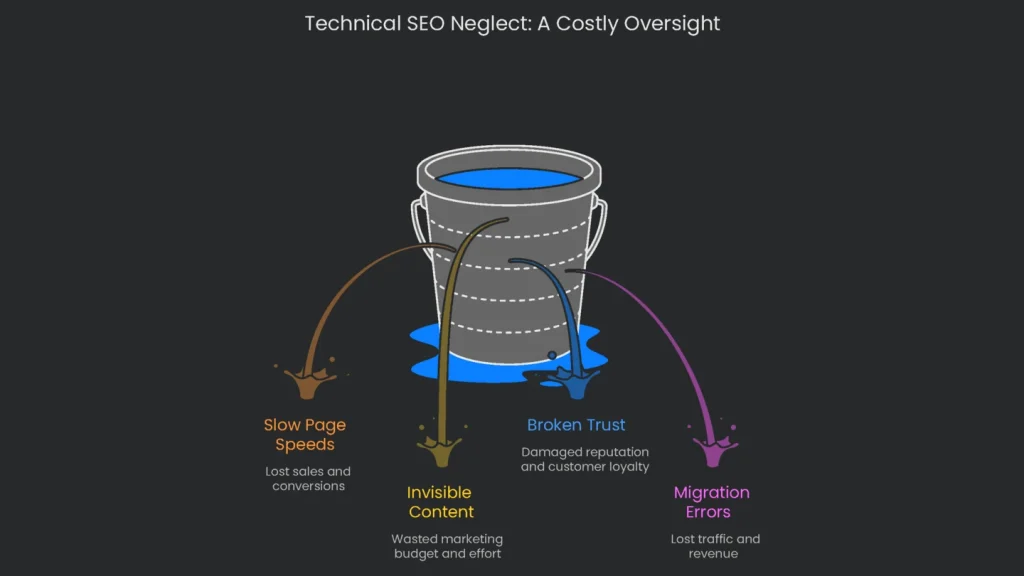
One of the loudest reasons to skimp on tech SEO is the old “I don’t hear the screech, so it can’t be broken” argument. This way of thinking pretends that ignoring code, loading speeds, and meta tags is a free pass. In truth, a shaky technical base is like a slow leak in the budget tire of marketing. Every day, data gets pinched, user experience drops, and search engines hesitate. As a result, missed sales, broken links, and rising bounce rates quietly pile on the bill. Delay rarely saves cash; it fast-tracks the final tab to a painful, pricey wake-up.
Slow pages drain your profits
Every millisecond a visitor waits for your website to load costs your business money. It isn’t a harmless wait; the delay stops potential sales and turns leads away. For example, almost half of shoppers want a page to pop up in under two seconds. Here’s the dollar damage delay causes:
- Sales Drop: When a page takes an extra second, sales shrink by 7%.
- Mobile Losses: For folks on mobile, the drop widens up to 20%.
- B2B Losses Count: A site that loads in a second converts three times better than a site that takes five.
- Carts Coast: The checkout page is easiest to abandon. One study links a 2-second delay to 87% of people leaving a cart.
- A Tiny Boost Matters: Google showed that speeding a page by 0.1 seconds lifts e-commerce sales by 8.4% and boosts the average cart by 9.2%.
There are real examples from top brands that show exactly how speed matters.
- Amazon found that when its page is even 100 milliseconds slower, it loses 1% of sales.
- Walmart tested gains and saw that when the page is just one second faster, sales climb by 2%.
- Vodafone tweaked a key speed number and saw sales jump 8%.
The slow-page penalty isn’t one-and-done; 79% of shoppers who encounter lag say they head for another store next time. Consequently, speed work compounds.
Invisible Content and Wasted Budget
Brands spend serious cash on content that’s supposed to guide, impress, and convert customers. However, CPU errors, rogue redirects, and lazy third-party scripts can leave crucial information invisible to search engines. If a page is unindexed, it’s like placing a perfect billboard in a locked garage-great headline, but parked in the dark where no one walks by. Money that could guide customers to checkout instead becomes a permanent write-off on the balance sheet.
The financial damage is clear. Picture a business that coughs up $15K for a research report. If a glitch locks the report behind a wall so only 300 people see it, that’s a $50 price tag for every eyeball-and hardly any profit. Beyond that, it eats up time, robs chances for new deals, and wears the whole team down. Eventually, the higher-ups start doubting content marketing, when the real issue is something as invisible as a missing code line.
That invisibility isn’t random; it shows up for technical reasons. Crawlers like Google only have so much “crawl budget“-a limit to how many pages on your site they read. If a bot spends that budget on 404 errors and low-ranking junk, the crown-jewel reports sit in the dust. A sneaky “noindex” tag or a messed-up robots.txt file can silently shut the door on key assets.
The High Cost of Broken Trust
Thankfully, there’s a fast fix for that firewall: an HTTPS certificate. When a site is secure, the URL shows a padlock, and that symbol is more than a pretty picture. For customers, it means their credit card stays private and their data stays safe. For companies, it’s a simple way to keep sales, protect their brand, and keep the crawler on the first rocket to money pages. Here’s what recent consumer trust statistics say you can’t ignore:
- According to a Neustar survey, 55% of people won’t trust sites that don’t visibly protect their personal data.
- A Vercara study found that 70% walk away from a brand after a security incident.
Just one breach can wipe out the brand loyalty you built over years. In 2021, lost business accounted for almost 40% of the average breach’s total cost, which was $4.24 million. As a result, a “Not Secure” banner can kill a checkout in retail. In B2B, missing credibility makes a lead vanish. Once trust drops, marketing campaigns cost more, too. You wind up spending extra just to win back confidence you’d already earned.
The Migration Minefield
When companies redesign a site, switch platforms, or relaunch, the marketing margins for error shrink. A fresh design can look impressive, but without technical SEO specialists on every call, that migration may silently wipe out years of SEO progress. A subheadline or a tag mismanaged for a day can mean a sudden loss of organic traffic that traces to every revenue growth goal. People meant to land on the site now land on search holes, which were the biggest traffic source in the first place.
The more the online change aims to improve the site, the bigger the dilemma. A site that’s broken under migration can destroy revenue. One major online store dropped 80% of its free traffic overnight after a migration. The site’s structure was rearranged, the wrong tools were applied, and Google was blocked from crawling most pages. The result? Empty shopping carts and blank lead forms. For executives watching the real-time dashboard, an 80% traffic wipe is not an “amazing headline at the analyst conference” risk. It’s a five-alarm, code-red crisis with flashing “revenue in free fall” banners. Therefore, even the tightest budget should earmark cash for technical SEO. The money spent here is the business’s fire extinguisher, not a moonshot.
Technical SEO as a Marketing Amplifier
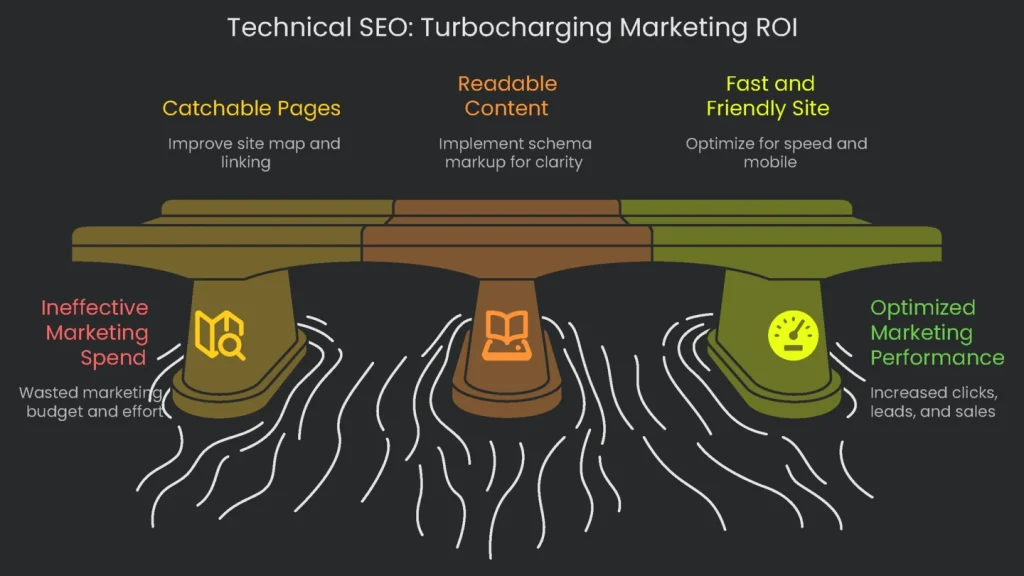
Fire extinguishers aren’t the only upside. A site that is technically sharp and optimized works like turbo for every other marketing dollar. Consequently, every keyword, ad word, and social post rides a smooth highway and converts better. Spending here stops the churn, and the leftover cash becomes fuel the whole marketing team cheers for. In short, the content is only a candle in a dark hallway without technical SEO. If that hallway is cracked and blocked, even brilliant content will splutter before it reaches its audience. The combination is simple: fuel, road, and speed produce dividends every month.
Here’s how the SEO team and the content team partner behind the scenes. First, the technical SEO piece makes sure your pages are A+ and ready to be found:
- Catchable: A logical site map, smart linking, and a polished sitemap signal, “Hey, robots, this is where the good stuff lives.”
- Readable: Tiny pieces of code called schema markup say, “Hey search engines, this is a recipe, this is a review, here are the star ratings!” They turn plain text into eye-catching features.
- Fast and Friendly: A speedy, mobile-ready site means visitors stick around. As a result, happier visitors improve search performance.
Skip this technical prep, and every blog post is like tossing a birthday card into the ocean and hoping your friend finds it. Do the tech work, and that card arrives in a flashy envelope at the right hour, bringing more readers and more revenue with it.
Boost Your Ad Budget
One of the clearest dollars-and-cents cases is this: good technical SEO makes your PPC fizz. If your brand runs Pay-Per-Click on platforms like Google, polishing your site stops you from paying twice for readers who could find you for free. Therefore, you get more clicks for the same budget and a calmer finance team. This aligns with Google’s official guide on Quality Score, which helps your ad dollars stretch further.
One big factor in that score is the page you send people to. Google rates it on relevance, trust, ease of navigation, and speed, especially on phones. In other words, the tech side of SEO targets the same factors. When you speed up pages, improve mobile UX, and lay out clear paths, you hand Quality Score a gift. Consequently, the score climbs, your cost per click drops, and ad spend turns into more clicks, more leads, and more sales.
Own the Advantage
Online, it’s easy for a rival to steal a keyword or mirror an ad. That’s why a bulletproof tech foundation is your secret weapon. When the code is clean, pages load fast, and the site is logically organized, you unlock an edge that can take years to duplicate.
Over months and years, a fast, safe, and organized site earns trust from visitors and search engines. Consequently, your name shows up in more places and your reputation grows. Unlike a flashy ad that stops when the money runs out, a solid technical backbone keeps giving. It’s a hidden strength that blocks competitors because users enjoy a smoother visit every single time.
Bridging Tech Talk and Business Sense
Translate Tasks to Outcomes
To translate geeky website chores into something the marketing team and the executive team both nod at, you must show how those chores drive business wins. Therefore, use a simple slide or chart as your translator. It lines up must-do technical SEO work-like speeding up pages or fixing broken links-with the sales numbers, visits, and loyalty stats the executives care about.
KPI Mapping
| Technical SEO Action | Key Technical Metrics Improved | Direct Business KPIs Impacted | The C-Suite Pitch: “What to Say to Your Boss” |
| Page Speed Optimization | (LCP and INP), Time to First Byte | Conversion Rate, Bounce Rate, Revenue | “Our page loads one second faster, and studies show sales could bump by 8%. That faster speed also means cheaper PPC, since lower bounce rates lift our Quality Score.” |
| Crawlability and Indexability Fixes | Index Coverage Ratio, Crawl Errors | Covered Pages, Organic Traffic, Content Marketing ROI | “Technical issues are hiding our top products from Google. Fixing this opens the vault, keeping our inventory visible and preventing competitors from snatching our search traffic and sales.” |
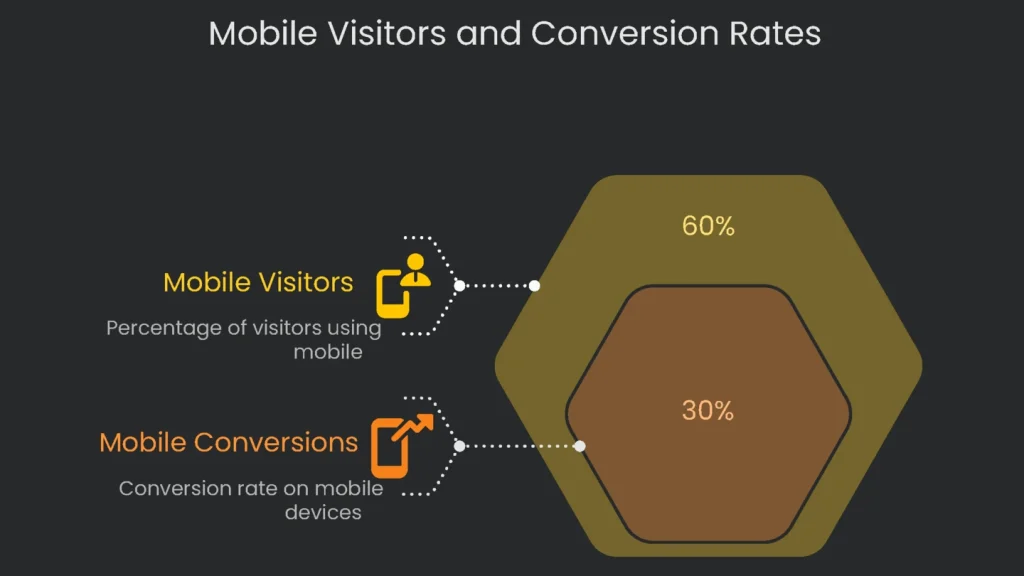
| Mobile-First Optimization | Mobile Usability Score, Mobile Page Speed | Mobile Revenue, Mobile Conversion Rate | “Over 60% of our visitors come by mobile, yet conversions are half of desktop. Mobile-first design can double that rate, unlocking a sizable piece of our total addressable market.” |
| HTTPS and Security Implementation | HTTPS Security Score | Brand Trust, Customer Loyalty, Conversion Rate | “Switching to fully HTTPS boosts trust, dampening visitor anxiety and turning leads into customers. Plus, we lower the risk of security breaches, keeping our brand and customers safe.” |
Security Proof Points
Fifty-five percent of online shoppers will walk away if they don’t see a security badge. That figure highlights why a modern site requires security to convert casual visitors into buyers. Therefore, treat it as the foundation of any successful online store or lead generator.
Schema and Architecture Wins
| Action | Impact |
| Structured Data Markup Clarifies SERP Real Estate | Real results, schema validation, and organic CTR, + qualified traffic, + more SERP space = a measurable boost-. When we add product reviews, real-time pricing, and custom snippets into the markup, we automatically claim more real estate on the search results page. Data from our case studies indicates that businesses leveraging structured data see click-through rates soar-up to 82 percent higher-compared to rival sites, all without a single dollar for additional ads. |
| Streamlined Site Architecture Strengthens Engagement | Pages per session, user paths, and user retention, + lead quality, + increased average order value. Thoughtful redesign of the site’s navigation point means visitors wind from page to page more smoothly, spending more time and landing on the highest-value offers. A carefully crafted user path results in stronger retention and, statistically, higher average order values. |
Build, Claim and Quantify Your Business Case
Numbers alone don’t get resources authorized. The team needs to go deeper and outline the financial case for SEO. Consequently, our step-by-step guide shows how to measure, calculate, and project ROI for the team-one dollar and one business metric at a time.
Figure Out Opportunity Cost
Start by sizing up the clicks and money you’re handing to rivals every day because of site issues. That number gives you the monthly “gain” you could reel in once your SEO tech fix fires up. Basically, it turns a sad “could have been” into a “we shouldn’t ignore this” red flag you must solve fast. Here’s a simple way to pin it down:
Grab the gear you need:
- Total Monthly Search Volume (MSV): Pull the monthly search count for your top keywords. A quick sneaky peek will do the job without big-budget SEO tools.
- Click-Through Rate (CTR): Check Google Search Console for your site’s usual click percentage. For “Target CTR,” eyeball the industry standards based on your rankings. (For example, top-spot CTR is roughly 30%.)
- Value per Visit: You get to pick your poison here:
- PPC Proxy Method: Snag the Cost-Per-Click (CPC) figures from Google Ads for your keywords. This frames your gain as ad dollars you no longer need to spend. Executives understand saved ad dollars.
Now you know what you’re missing. Next, let’s fix it.
Find Your Value Using the Right Conversion Value Method
Complete the formula:
Check your average page-level conversion rate inside Google Analytics, and grab the average lead or order value from your sales records. Consequently, you’ll have a defensible value per visit.
Project Your ROI
Take the gain you just calculated and use the basic formula:
- Gain from Investment: Use the value from the Conversion Value Method as your projected gain per month.
- Cost of Investment: Use the entire cost of the project-whether that’s the agency quote or the blended cost of in-house salaries and required software.
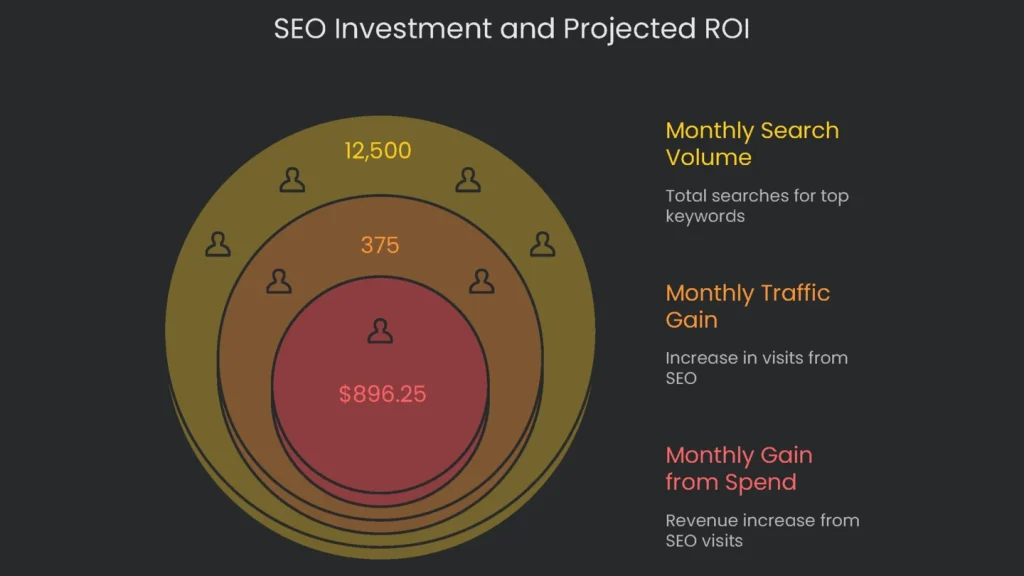
Example: A B2B company wants visibility for keywords totaling a Monthly Search Volume of 12,500. Today the average rank is 8, with a click-through rate of 3%. The aim is rank 5, where expected CTR is 6%. Each lead’s value is $45, and 5.3% of visitors convert from organic search. A technical project to boost the site is proposed at $5,000.
Calculation:
- Revenue per Visit: $45 (lead value) × 5.3% = $2.39.
- Monthly Traffic Gain: 12,500 (searches) × (6% – 3%) = 375 visits.
- Monthly Gain from Spend: 375 (visits) × $2.39 (value per visit) = $896.25.
- Projected First-Month ROI: ($896.25 – $5,000) ÷ $5,000 × 100 = -82.08%.
- Projected 12-Month ROI: (($896.25 per month × 12) – $5,000) ÷ $5,000 × 100 = 114.65%.
This math shows the full investment isn’t recouped right away. However, the project is expected to deliver a positive return of over 114% by year’s end. That’s a strong number to bring into any budget meeting.
Present Your Case Effectively
How you communicate the numbers is as crucial as the numbers themselves. To encourage the go-ahead, organize your pitch this way:
- Begin with the Business Problem: Open with a concrete opportunity cost, like “We could gain an extra $10,700 in revenue annually due to lower-than-expected visits.” Position the discussion in terms of revenue, not just plans.
- Use Visuals: Create a clear, single-slide chart that shows revenue rise over the first year, broken out by each month’s gain. A quick picture is easier to absorb than dense numbers when the clock is ticking.
- Meld with Company Targets: Tie the project’s success to the business’s big-picture missions. For example, “This funding helps hit our goal of boosting qualified leads by 15% this fiscal year.”
- Anticipate Pushbacks: Preempt doubts. For the “SEO takes forever” worry, point to immediate risk reduction (like locking down the site). Then stress the compounding power of the investment.
Shift from Expense to Growth Catalyst
Make the Financial Case
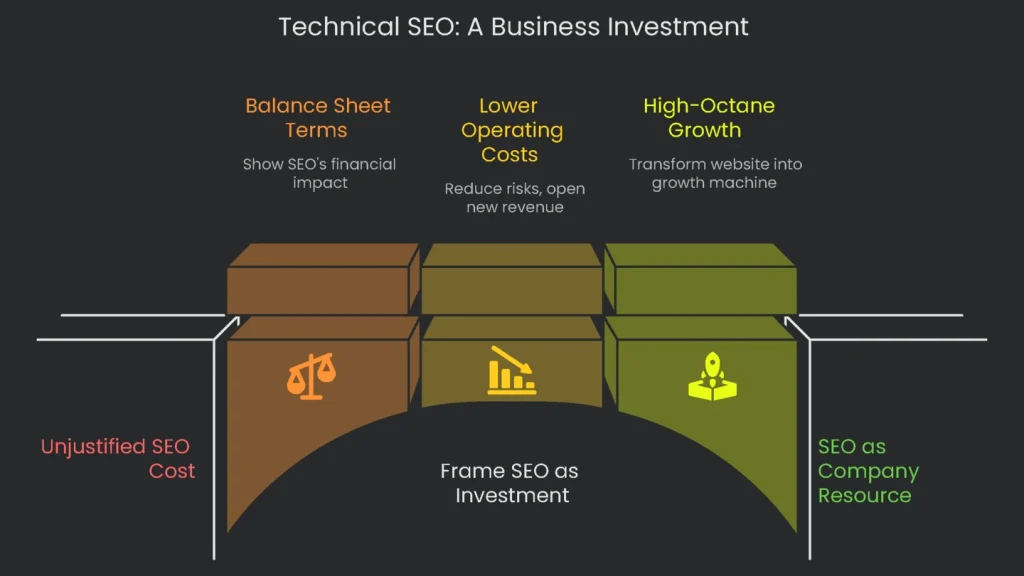
Tagging technical SEO as a mysterious, hard-to-justify cost means the message hasn’t bridged to the business. Frame the argument in balance-sheet terms, and a well-built site emerges as a must-have company resource. It directly amplifies profit for every digital marketing dime spent.
Turn SEO into a Flywheel
It sets the stage for a knockout content approach, drives down the cost of acquiring new customers, and builds a durable edge. Everything that follows helps marketing leaders cut through buzzwords and show a hard-nosed business case. Asking for budget to tackle technical SEO isn’t “adding another marketing line.” It’s a meticulous, number-grounded project that lowers operating costs, shrinks major risks, and opens new paths to revenue. Lay this plan out clearly, stand behind it, and you’ll gain the funding to transform your website into a high-octane growth machine.
Implementation steps
- Anchor goals in revenue proxies like quality traffic and conversions.
- Clear crawl and indexation traffic jams, then turbo-charge speed and uptime.
- Thread internal links and structured data into the nerves of key revenue pages.
- Flip on monitoring—logs, GSC, and real-user metrics—then scream when things drift.
- Review headline KPIs each month; launch a targeted growth test and ship it
Frequently Asked Questions
How does technical SEO help my site grow?
It makes sure search engines can find your content quickly and trust it, which boosts both traffic and conversions.
What do you actually provide?
We run site check-ups, implement fixes, oversee big moves to new platforms, keep a watch afterward, and run tests to drive even more growth.
Is this only for large websites?
Not at all—every site grows stronger when the basics are sound.
How quickly will I notice a difference?
Changes build on one another—some improvements are visible right away, while others take days or weeks.
Do you keep working with me?
Yes—we offer ongoing month-by-month support or “project sprints” depending on your goals.