
As SERPs continue to address more questions inline, your technical excellence and structured data optimization continue to elevate your brand. Find out how to get visibility when clicks decrease.
The New Reality: Clicks to Citations
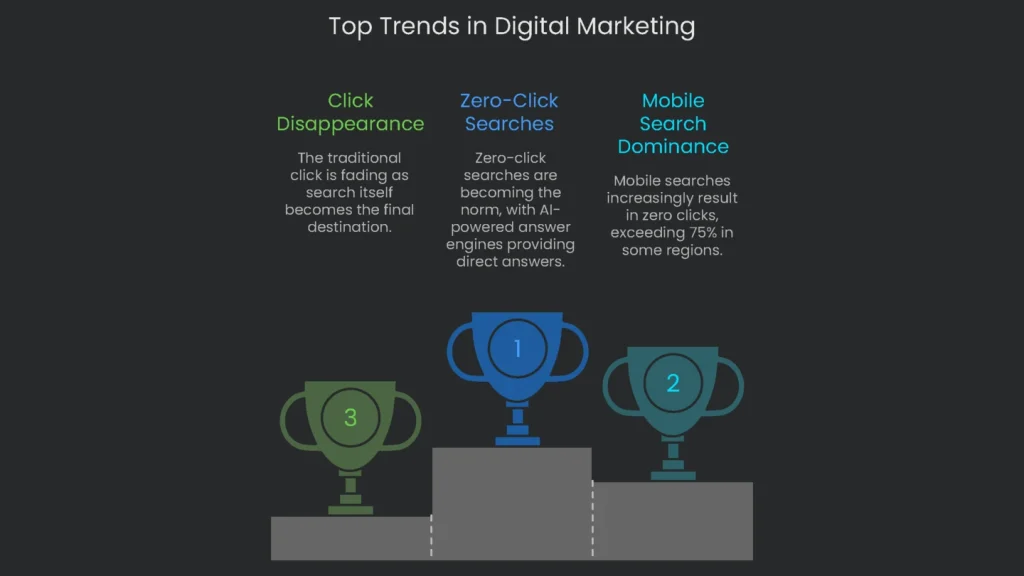
In short, everything is changing in digital marketing, and clicks aren’t the prize anymore. People now treat search results as the final destination. Therefore, “zero-click searches”—where the answer appears and no website is visited—are rising, thanks in part to smarter, AI-powered answer engines. SEO isn’t finished, but our focus must change. The target is no longer to drive a click; the aim is to be the trusted answer, plain and simple.
For example, 2024 data show 65% of all Google searches resulted in zero clicks—up from 50% five years earlier. By 2025, we’ll be pushing past 70%. The pattern is similar in the U.S., where close to 60% of searches take no click. On mobile, that number is over 75%. As a result, the click is disappearing, and the search itself is the destination.
Google’s AI Overviews
Consequently, the rollout of Google’s AI Overviews matters. These summaries use generative AI to pull data from numerous sites and stitch a tidy response at the top of the results. Instead of a list of links, users see a full answer in seconds. Therefore, the bar for easy, fast information is higher than ever.
Companies that rely on free search traffic are watching the math. Research finds that with an AI Overview, sites can lose organic traffic for info-based searches by between 18% and 64%. As a result, what once felt like a warning now hits the bottom line. The chances for both sales and new leads shrink quickly.
Since results pages are more people-centered and AI-powered, we can’t judge success the old way. Numbers like click-through rate and raw organic traffic are losing punch. For example, impressions and rankings can climb while overall clicks drop. That’s normal now, because AI answers a user’s question on the panel, so a click isn’t needed. However, the page that provided the concise knowledge still wins because it is presented as the trusted source. Focusing only on clicks would miss that success.
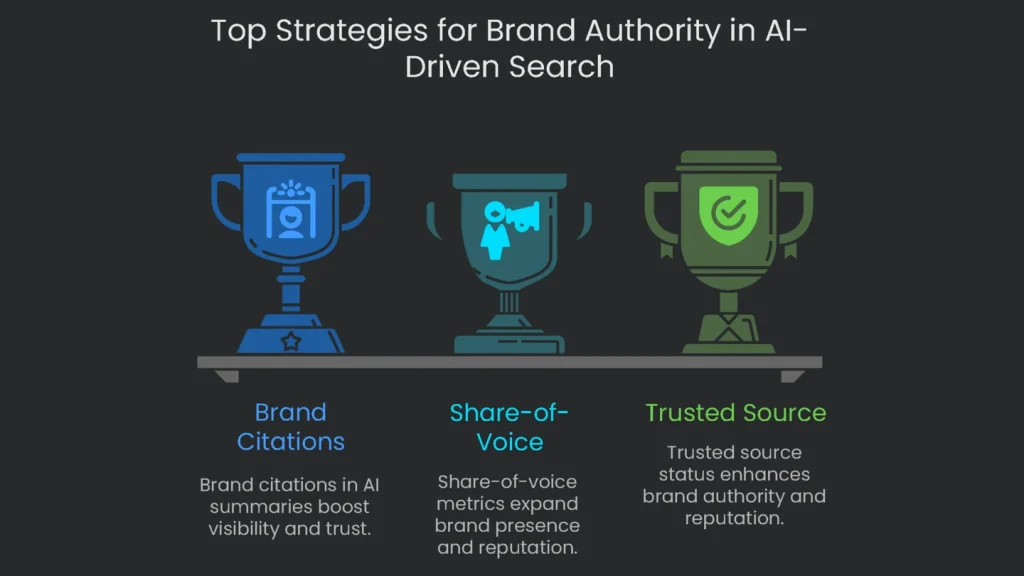
Therefore, the field must switch to fresh metrics that count visibility, such as brand citations in AI summaries and an expanded share-of-voice that covers all mentions. With those updates, search shifts from traffic builder to a powerhouse of brand authority and reputation upkeep. The instant an AI panel cites a brand, that brand gains a slot in the user’s trusted mental folder. Even without a visit, it is noticed and retained. In other words, the search page is now a marketing channel that answers questions, validates authority, and shapes reputation in one sweep, without needing foot traffic.
Finally, building the tech muscle that feeds the machine adds real brand value. Stopping to celebrate today’s incoming traffic no longer counts. The company of tomorrow wins by becoming the go-to source that both people and machines trust most.
Technical SEO is the Secret Sauce
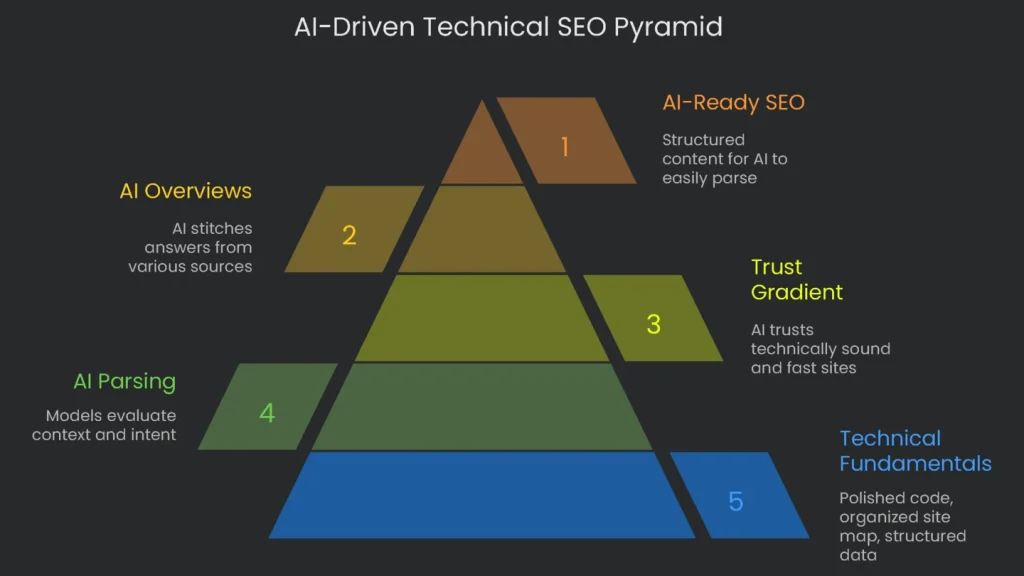
In the AI-first horizon, the practice of technical SEO is ramping up in importance. The pivot is clear: tech SEO is the new on-page SEO. The old playbook tweaked what you could see—nesting keywords like Easter eggs in headlines and body copy. However, as the search-result page becomes the top of the funnel, the spotlight shifts to architecture that only a machine admires. The syntax behind each line of code is the new level, and how a site wires up its data supersedes where it drops in search terms.
Moreover, the latest AI tools go far beyond keyword matching. They evaluate context, intent, and how concepts connect. Therefore, throwing the right words onto a page won’t cut it. Your target is to make it simple for models to parse key points and reuse them to serve the best answers. That means nailing technical SEO fundamentals—polished code, an organized site map, and, above all, the right structured data.
The new AI-driven features look for information from sources they view as reliable and authoritative. They run on a trust gradient. A big part of trust stems from technical health: a site’s loading speed, its security, and how smoothly it can be crawled. If a site is not technically sound, the AI flags it as dubious. When two pages look equally trustworthy, the cleaner, faster one wins. Consequently, technical performance is a gatekeeper, not a bonus. If a page can’t pass the backend check, the AI won’t even read the headlines.
Think of AI reading a page like a detective gathering clues, not a person soaking in a story. It hunts for facts, names, and relationships. AI Overviews grab bits from many places and stitch a new answer in seconds. So the page’s job is to hand over the pieces in an easy-to-read fashion. That’s where technical SEO shines. Schema vocab, clear heading hierarchies, bullet lists, and tables signal, “Here’s the nugget you want.”
Your toolkit for AI-ready technical SEO still starts with users. However, the new layer is the structured frame you wrap around content so engines won’t miss it. Success means fingerprinting meaning and context so precisely that the crafted answer aligns with your content. Next, dial in four vital arenas of technical SEO where labels, lists, and levers point to key facts and their relationships.
Structured Data: AI’s Favorite Talking Points
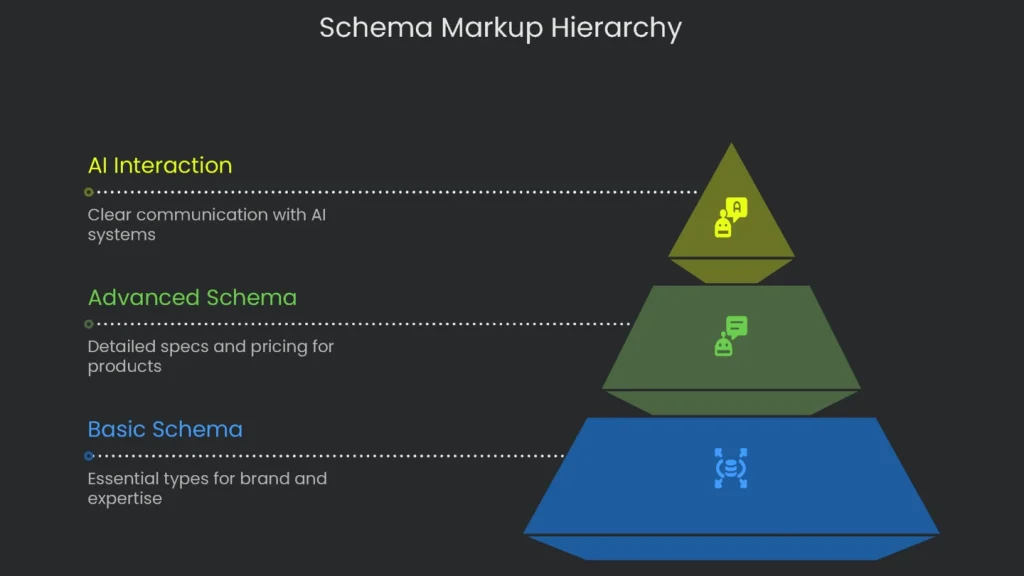
If you hop over to Schema.org markup, know it’s not a boring backend gizmo that merely pretties up a results page. It’s the secret handshake sites use to chat with AI. Instead of whispering into the web’s ear, sites can send clear, tested info about what they do, who they are, and what they offer. That extra neatness helps push back weird “facts” AIs sometimes invent, because plain text can confuse models. Microsoft’s shown that its LLMs peek at schema markup to “read” pages more accurately. All signs suggest pages with solid structured data are the ones that look right when AI generates answers. Therefore, package information in an agreed standard such as schema markup. Use that standard, and AIs read your pages like instructions written in your language.
A practical move is to add both schema styles. JSON-LD whispers structured tips to search engines, while microdata lays the smorgasbord for chatbots. For essentials, prioritize these types: Organization for brand identity, Author/Person for expertise, FAQPage and HowTo for direct answers, and Product or SoftwareApplication for specs and pricing.
Generative Engine Optimization
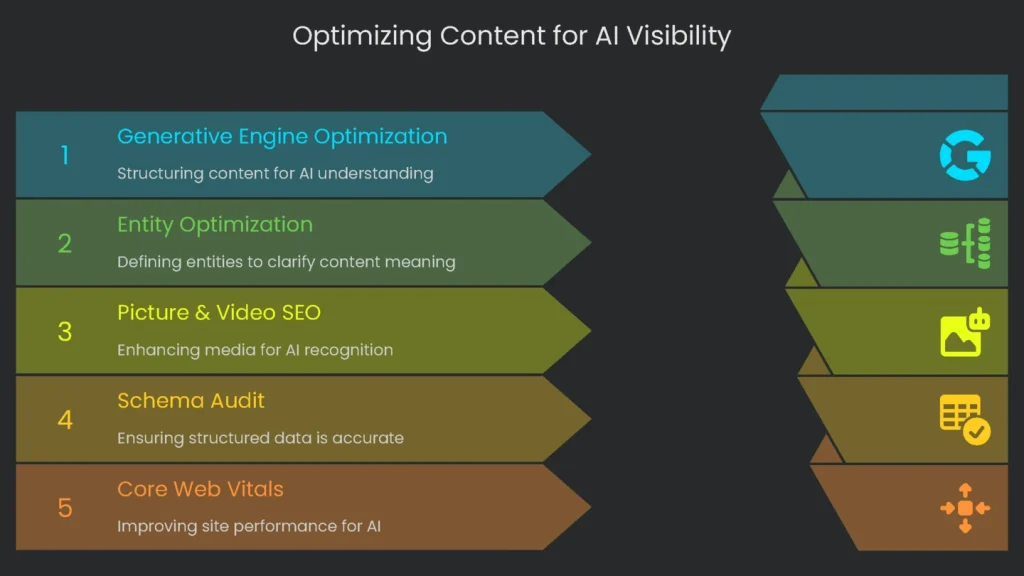
Next comes Generative Engine Optimization, or GEO. Rather than blasting keywords and hoping for a link, GEO packages fast-to-parse, clear info. The goal is not only to show up but to hand context to the AI so your answer slides to the front.
Moreover, your HTML layout can guide crawlers like breadcrumbs. Start with one clean <h1> for the main topic, group big ideas with <h2>, and add <h3> for details. Keep sentences short, use lists, and add tables to chop complex info into bite-sized chunks. An effective GEO trick is the “answer-first” layout: place a concise answer directly under the heading to raise your odds of being quoted.
Entity Optimization
Today’s search depends on entities—specific, well-defined things that AI can pinpoint. An entity might be a person, city, company, product, or any singular idea. Entity SEO spells out the entities tied to your brand and maps their links. For example, when you say “Apple,” you clarify whether you mean the company or the fruit. Consequently, search engines build a clearer picture of your expertise.
In practice, it comes down to structure and connections. First, use tidy URLs like your-site.com/services/technical-seo/. Next, add smart internal links with meaningful anchor text. Consequently, your site becomes a mini knowledge graph—an organized library crawlers and users can navigate with ease.
Picture & Video SEO
Today, AI stories don’t stop at words. They pack in photos, videos, and graphics to keep viewers engaged. As results look more like a gallery, polishing images and videos shifts from nice-to-have to must-have in your technical SEO plan. Otherwise, it’s like leaving the lights off in a digital showroom.
If you want to succeed here, lean on the tech side.
- First, pick filenames that describe the asset. Instead of
IMG_4815.jpg, useai-overview-schema-example.webp. - Second, write strong alt text. Good descriptions help both visually impaired users and search engines.
- Third, add the right schema. Use ImageObject for images and VideoObject for videos. As a result, AI can identify, trust, and share your media more often.
- Finally, write a few sentences near each asset that tie it to the page’s topic. Consequently, you tighten relevance for humans and robots.
Your Technical SEO Action Plan
Time for a playbook. The pie is shifting toward AI-driven search, and you don’t want to miss a slice. Therefore, the next sections list the exact moves to build a rock-solid technical foundation for the zero-click future.
Schema Audit Checklist
Start with a full audit of your structured data. Use the Schema Markup Validator to find and fix errors, then locate gaps. Focus on priority pages—guides, services, and products—to identify missing schema types that would help AI summarize and retrieve your info.
| Schema Type | Primary AI Role | Quick Tip for Setup |
| Organization | Marks your brand as a real, trustworthy site | Place it on homepage and About page. Please link all company social profiles and the relevant knowledge panel, like a Wikipedia page for brands. |
| Author/Person | Creates E-E-A-T by connecting a real expert to the content | Direct author names to brief bio pages with credentials and notable publications. Use knowsAbout to highlight the expert’s skill areas. |
| FAQPage | Delivers clear, pre-planned Q-A pairs for featured snippets | Place it on top service and product pages to answer recurring questions and clearly steer how info will be shown. |
| HowTo | Breaks tasks into step-by-step pieces AI can list as guides | Apply it to how-to stories. Keep steps compact and to the point, ensuring a clear, logical sequence. |
| Product/SoftwareApplication | Feeds the AI full product info (features, pricing, user ratings) for selling questions. | Double-check the numbers and wording align with the source page. Pull review scores from aggregateRating markup. |
| ImageObject/VideoObject | Gives the AI simple ID and context for pics and clips, boosting the chance they’ll show up in search. | Nest these inside the main content schema (like Article or Product) and polish filename and caption for clarity. |
Improve Page Layout
Structure the page so people and AI can read it easily. Do this with simple formatting rules:
- Use one
<h1>on the page for the main title. - Use
<h2>and<h3>hierarchies to slice heavy content into parts. - Turn long paragraphs into short bulleted or numbered lists.
- Use bold and italics to call out words to remember.
- Finish with a “Key Takeaways” box at the top of long articles to summarize fast.
Focus on Core Web Vitals
If you want AI on your side, deliver a great page experience. Bad loading speeds will push you out of its favorites list, so nail Core Web Vitals. The three numbers are Largest Contentful Paint (LCP) under 2.5 seconds, Interaction to Next Paint (INP) under 200 milliseconds, and Cumulative Layout Shift (CLS) below 0.1. These come from real users, so they reflect true performance.
To reach those scores, start with sharp image compression. Switch to WebP and cut file size. Next, remove code that blocks rendering, enable browser caching, and choose a CDN to shorten request distance. Consequently, both users and AI see a high-quality, ready site.
Tidy Up Your XML Sitemaps
Think of XML sitemaps as navigation maps for search engines and AI models. To help them locate and correctly grasp your best content, keep sitemaps clean, complete, and fresh. Schedule audits to remove broken links, faulty redirects, and low-quality or duplicate pages that waste crawl time. Don’t skip the <lastmod> tag, which shows the up-to-the-minute status of pages. For fast-changing topics, being the latest can make or break relevance.
Wrapping It Up: What Technical SEO Is Really About
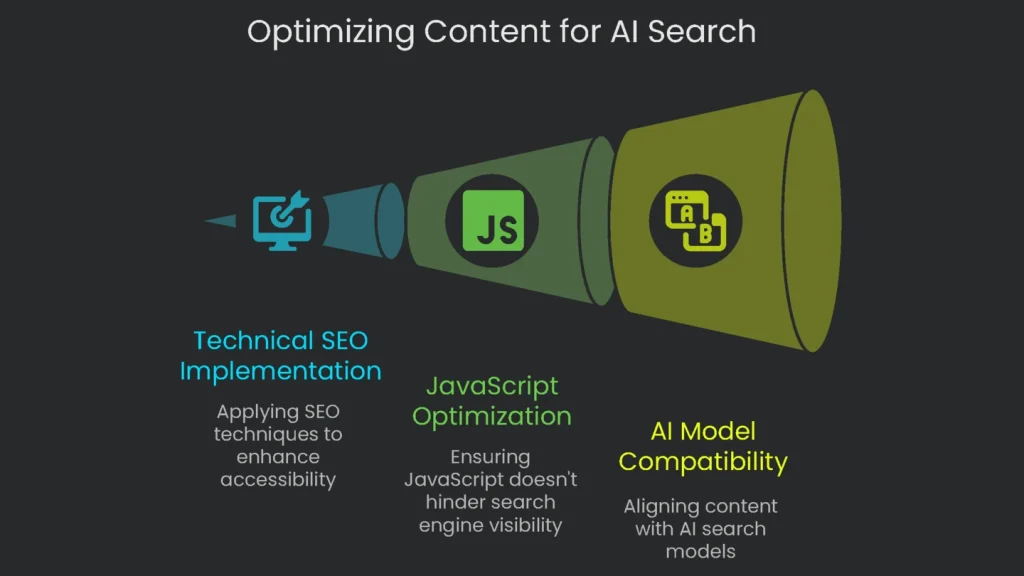
Search is bubbling with a swift and serious shift. Tools, methods, and even how people search are changing. Yet the cornerstone of technical SEO—what it aims to achieve—has stayed the same and grown more crucial: make your content smooth to access and easy to ingest for the main search surface. Once, that surface was a crawler building link lists. Now, it’s AI models that digest data to output clear answers. Therefore, focus your energy there, and your content stands a better chance of being the model answer.
Technical SEOs have evolved from quick tweakers into builders of digital frameworks. With AI shaping what we see online, smartly organized data isn’t optional—it’s the grid a brand’s presence runs on. To stay trusted through the next algorithm shift, brands must upgrade that sitemap-stacked scaffold now. Otherwise, they risk looking like empty links later. Companies that invest in this core layer today will soon show up in the answer box, not just the carousel.
Extra reading: For a sneak peek at the next wave of changes, hit these predictions.
Implementation steps
- Scan the SERP for features in your target queries—snippets, FAQs, images, and videos.
- Layer structured data and sharp answers to claim real estate on the SERP.
- Speed up the site and tighten UX to crank engagement metrics.
- Publish topical hubs that the web wants to mention and link.
- Track impressions and brand queries as closely as clicks
Frequently Asked Questions
What’s ‘zero-click’?
When the SERP answers pop up and most people skip the page altogether.
How does tech SEO fit?
Make data tidy, compress page weight, and wireframe it so we appear first.
Should I chase featured snippets?
Definitely—frame answers well and sprinkle schema; repeat for brand memory, too.
How do I see the numbers?
Count impressions, gauge which widgets appear, and watch brand phrases, too—not only raw visits.
Will zero-click ruin my traffic?
It adjusts browsing patterns—opt for SERP dominance and design eye-catching next steps.