
Technical, Content, and Authority triad power sustained growth. We illustrate how to balance the three, deepen the topic, turn the links and UX to durable rankings.
The free SEO starter guide from Google is gold. However, whenever I show it, people squint at me like I just challenged them to a Rubik’s Cube. After all, the rules shift day to day thanks to new code and layers of code. Algorithms and a mountain of factors seem like flip cards from one moment to the next. In short, buried in the slide deck of skimmed mystique is a single, unbendable tile.
SEO Factors
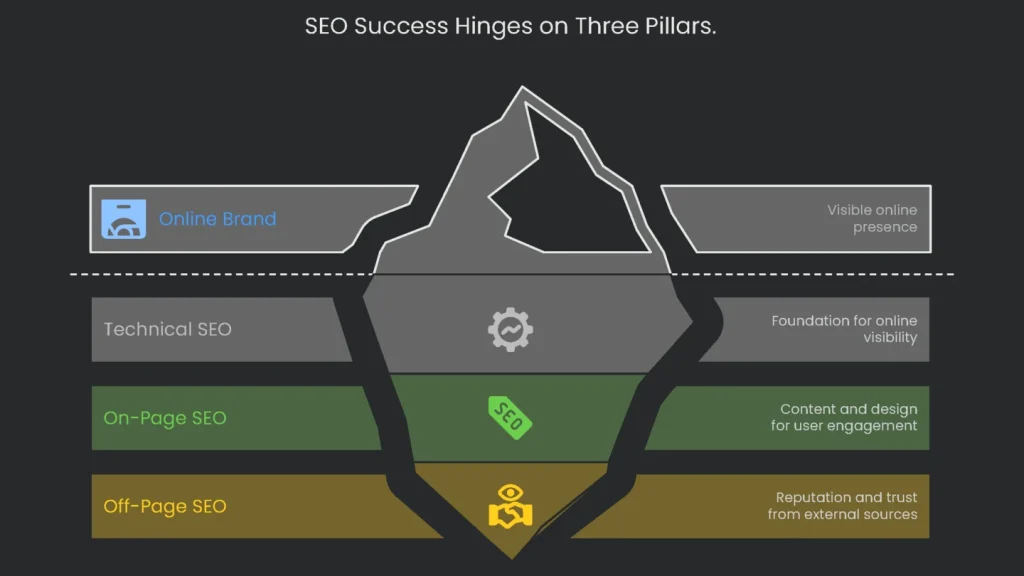
The truth is, SEO lives and dies by three pillars. Picture it like building a treehouse with your friends. Biodegradable wood, fairy stickers, and one purple screw get you nowhere. Therefore, you glue a leg, you hammer a leg, and—boom—the thing threatens to defy gravity. The treehouse and a healthy online brand depend on the same secret: three tightly knit beams.
- The Footings (Technical SEO): Shell and rope ladder look snazzy, but you wouldn’t lean on beams without beds of concrete underneath them. The invisible part does the real lifting. In the SEO game, the invisible limb is Technical SEO.
- Content & Design (On-Page SEO): Once the concrete is dry, you fill the home with color. You arrange the living room, choose the plants, and ensure the Wi-Fi is strong in every corner. Without cozy rooms, nobody lingers. This is the day-to-day cozy experience—On-Page SEO.
- Reputation & Trust (Off-Page SEO): Now imagine friendly neighbors handing you “Welcome” brownies and posting glowing reviews. The bright curb lights and flowers draw more visitors. When the street hears you throw great barbecues, the house is worth more. This charm comes from outside—Off-Page SEO.
Each pillar counts, but one carries the most weight. Think of a house rule: start with a great slab, or the rest leans and cracks. You could fill rooms with seven kinds of cheese. However, on a shaky slab they crumble.
Technical SEO
What is Technical SEO?
Technical SEO is the hidden magic. It manages the dust behind the drywall—fixing leaky pipes, tweaking the server to load quickly, and dressing every page in a digital uniform search robots love. As a result, when lights, power, and roads work right, visitors and search engines arrive and leave happy.
Think of your website like a subway, and you’ll see how everything depends on the tech tracks. The content you put on each page is the train, the stations that link to you are the outside websites, and the tech bits—like rails, signals, and the powerhouse—are the technical SEO. If those rails have holes, no train rolls. Consequently, no one hops on, no one sees your amazing articles, and that shiny content and all those nice incoming links become extras that can’t help the system shine. Therefore, this tech side has to come first, and here’s why: a wonky platform keeps everything else wobbling.
Picture pouring money into the most interesting train—top-notch articles—yet the rails are rusty. Traffic, money, and creativity are wasted the moment search engines like Google can’t hitch a ride. No crawl, no index, no pizza fumes wafting into the tunnels to grab that hungry crowd. As a result, the info and authority can’t pull their weight if the gears and gadgets jam the tracks. So, get the tech stitches in, and everything else builds on a smooth ride.
Lots of technical hiccups can trip you up harder than any minor ranking drop. For example, a tiny mistake like slipping an unintended noindex tag onto a page can freeze it out of search results entirely, wasting the optimization work you’ve already done. Therefore, the first step in any solid SEO game plan is a complete technical health check—think of it as an oil change before the road trip. Everything else is built off that tidy foundation.
Search engines, especially Google, have a similar view. Their tools only have so much time to crawl any site, which techs call a “crawl budget,” and they allocate it to pages that load fast, look organized, and are coded cleanly. Consequently, a tidy site is like a fast lane—quick, low-cost, and simple to process. A jumbled, code-heavy mess is the road construction they’d rather avoid. Build a solid, slick framework, and they’ll stand in line to boost your crawl priority, which is the first step toward showing up in the search results.
Key Elements of Technical SEO
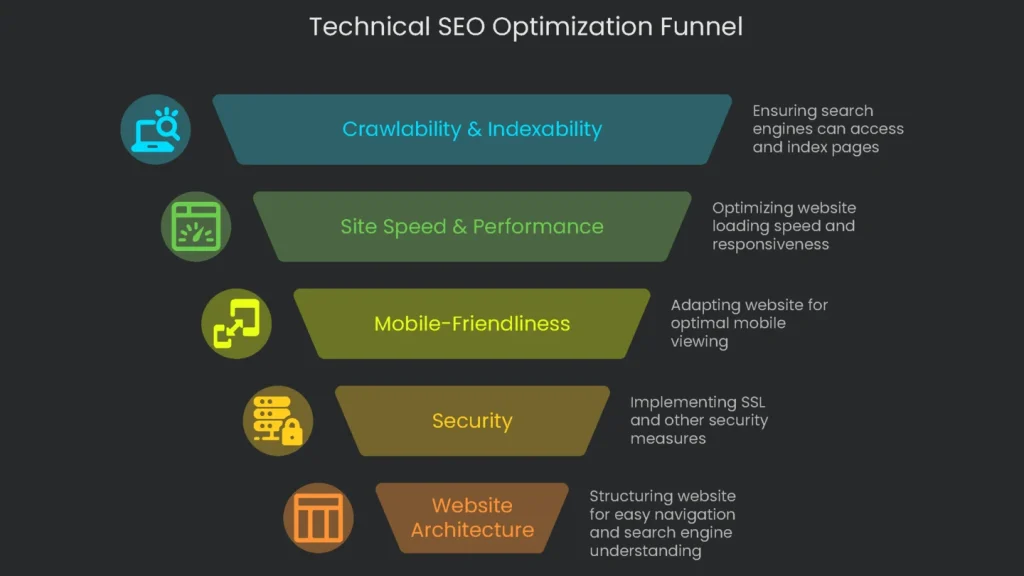
Getting your technical side right involves combining a few must-have ingredients that work together to keep the site fast, open, and safe.
Crawlability & Indexability
Crawlability means letting search bots discover your site’s pages when they roam the web. Indexability then means giving bots the green light to save and include those pages in search results. No crawl, no index. To control access and organize your pages, here are the top tools to use:
- XML Sitemaps: Picture this as a treasure map for bots. The sitemap lists the most important pages, guiding crawlers to where the gold—your content—really shines.
- Robots.txt: Think of this as a bouncer for crawlers. The robots.txt file tells search bots which doors they can enter and which they should steer clear of.
- Internal Linking: Good links inside your site form a clear path. Without links pointing to a page, that page is an “orphan.” Orphans are hard for crawlers to find, so they might not get included at all.
- Canonical Tags: When a page dresses in different clothes (same content, different URLs), canonical tags show bots the “one true” version to trust. Consequently, the tags keep duplicates off the search results stage, boosting the ranking power of the main page.
Site Speed & Performance
Site speed is how fast a page pops to life and lets a visitor start clicking. It matters for ranking because Google watches how long a visitor waits. If they leave fast, even the best content can sink. Google also provides Core Web Vitals that track how a page loads, how fast it reacts, and how stable it looks while loading. If the page jumps around, that counts as bad. Therefore, to speed things up, images can be compressed, code can be cleaned, and a visitor’s browser can store key bits for a quicker replay.
Mobile-Friendliness
Mobile-friendliness means a website is easy to tap on, no matter the screen size. It’s not a nice extra anymore; it’s a rule. Therefore, Google has switched to “mobile-first indexing,” which means it looks at the phone version before anything else. If a site is clunky and hard to scroll on a phone, it gets a ranking penalty because most people browse that way.
Security
SSL (HTTPS) shows people and search engines that your site is zipped shut like a vault. It uses the little padlock in the address bar. Nobody likes dodgy vibes, so Google and Chrome raise red flags. They also tell users, “Skip the danger, keep your data.” As a result, those safety signals keep your rankings and your clicks safe, plain and easy.
Website Architecture
Website architecture is like your house’s floor plan. When doors, stairs, and closets are placed right, visitors know where the snack cupboard is—and so do Google’s robots. For example, trim your tangled URLs to clear names like “/chocolate-chip-recipe,” and keep key pages no more than three clicks deep. In short, that spreads the “page juice” so every guest gets authority and nobody gets lost in the basement.
On-Page SEO
What is On-Page SEO?
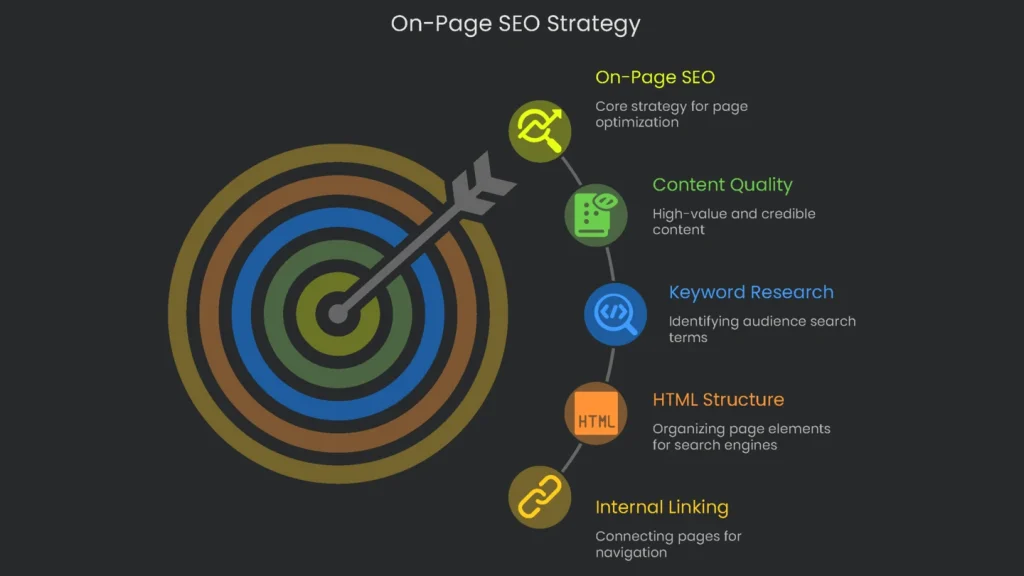
After getting the technical backbone sorted, the next spotlight is your site’s pages, where text and design work as a team. On-Page SEO—sometimes called on-site SEO—means tuning the things you can change yourself: the words, headings, images, and behind-the-scenes code. In short, it’s a clear postcard to both visitors and search engines: “Here’s what this page is about and why it matters.”
Why On-Page SEO Matters
On-Page SEO exists to make sure every piece of content is exactly what real people want. You can spend ages coding a beautiful site, but it’s a paperweight if the pages don’t say anything useful. For example, imagine your site is a house: every room (or page) has a theme (the search the user typed). Your job is to fill that room with valuable, attractive decor (the content) that makes visitors want to linger. Consequently, when every page is done right, search engines see a clear map of what’s relevant and send the right people to you.
Keyword Research & Search Intent
Before you write, find the exact words your audience types into the search bar. That’s keyword research, and it’s the backbone of any successful page. However, it’s not enough. You also need to spot what searchers want to achieve. Someone typing “how to fix a leaking sink” wants a tutorial. Meanwhile, “top-rated sink faucet” means “sell me the best one.” Content that fits the searcher’s biggest question earns stamps of approval from search engines. Ignore this, and the page may vanish into the digital shadows.
Content Quality & E-E-A-T
Now that you know what the reader wants, write content that delivers clearly and credibly. Google rewards pages that shine with E-E-A-T—for Experience, Expertise, Authoritativeness, and Trustworthiness. Experience means the author has actually used the product. Therefore, that one firsthand story elevates a piece from the average resume. The result is a page that not only ranks, but also speaks to the reader with familiarity and confidence.
- Expert Insight: The piece springs from a specialist who showcases solid education and real-world experience.
- Established Authority: The author and the site already rank among the go-to names in the subject area.
- Built Trust: The page runs on secure servers, links to its facts, and presents the author’s name, position, and bio in an easy-to-find spot.
When information brings distinctive viewpoints and trusts the skills behind it, it banks the kind of traffic that sticks for the long haul.
Key HTML Pieces
Three HTML tags work like clear classroom labels for Google and its friends:
- Title Craft: This small line shows as the tab heading and the bold line in search lists. Nail it, and you tell both people and Google, “This is what the page is really about.” Consequently, a sharp title grabs clicks and climbs the Google ladder.
- Meta Remember: This tidy phrase fills in the line of text under the title in search lists. Google doesn’t count it for points, but a catchy version can pull visitors in the door.
- Head Organizers (H1, H2, etc.): These markers keep the notes tidy. The H1 tells the main subject. H2s and H3s add side points. This helps readers and every search robot scanning for topic cues.
Internal Linking
Think of internal links as the hallways between the classrooms of your website. When you add a link from one page to another page of your site, you build a shortcut that lets both visitors and search engines move around more easily. For people reading the page, the link is a friendly nudge to check out more useful stuff. Meanwhile, search engines use those links to map out the whole building, find the closets, and decide which rooms deserve the most light. Therefore, when you use a few clear words in the link—the anchor text—you give search bots a hint that the linked page is a starred resource on that topic.
On-page and off-page factors don’t just rub shoulders; they support and strengthen each other in a nonstop cycle. To make the Authoritativeness and Trustworthiness parts of E-E-A-T truly count, they must be backed up with outside proof. That outside proof comes from other respected sites linking to you, and that linking is the heart of Off-Page SEO. Consequently, when Off-Page SEO gives you a citation, it says, “Those claims of authority are legit.” The cycle then spins back: the safest way to grab those outside links is through content that shows real Experience and genuine Expertise. In short, original research, fresh data, and one-of-a-kind insights attract the strongest backlinks.
Off-Page SEO
What is Off-Page SEO?
After you’ve locked in a clean technical setup and filled your site with high-quality pages, the last secret to success is raising your website’s good name across the internet. Off-Page SEO covers every step taken away from your own pages to boost reputation, authority, and ranking in Google’s results. Imagining SEO as a job applicant helps. On-page SEO is the slick resume and perfect outfit, while Off-page SEO is the stack of glowing references that prove you’re the real deal. Therefore, it’s about getting the right people to say, “Yeah, they totally know their stuff.”
Why a Stellar Reputation is Key
Picture the web as one massive spider web, and the spiders are the search engines. Every time one page links to another, it’s like making a handshake the web can feel everywhere. If a respected expert site extends that handshake, the newcomer instantly looks more trustworthy. As a result, the more respected the original handshake-maker, the louder that vote is. One mention from the right voice can outshine a thousand from sites nobody knows. Therefore, Off-Page SEO is the ongoing mission to collect those powerful endorsements that build unbeatable online street cred.
Why Off-Page Signals Matter
When we talk about SEO, it’s crucial to know the difference between the stuff you control and the stuff you can only influence. Your On-Page SEO—title tags, headers, and keyword placement—is in your control, which is great. However, it also means it’s easier to game. Off-Page signals don’t play by the same rules. A link from a leading news outlet or a five-star review can’t be ordered like pizza. You earn it by doing work that’s actually useful. Consequently, because you can’t fabricate those links and reviews, search engines see them as trustworthy. That’s why they carry so much weight in ranking formulas.
The Building Blocks of Off-Page SEO
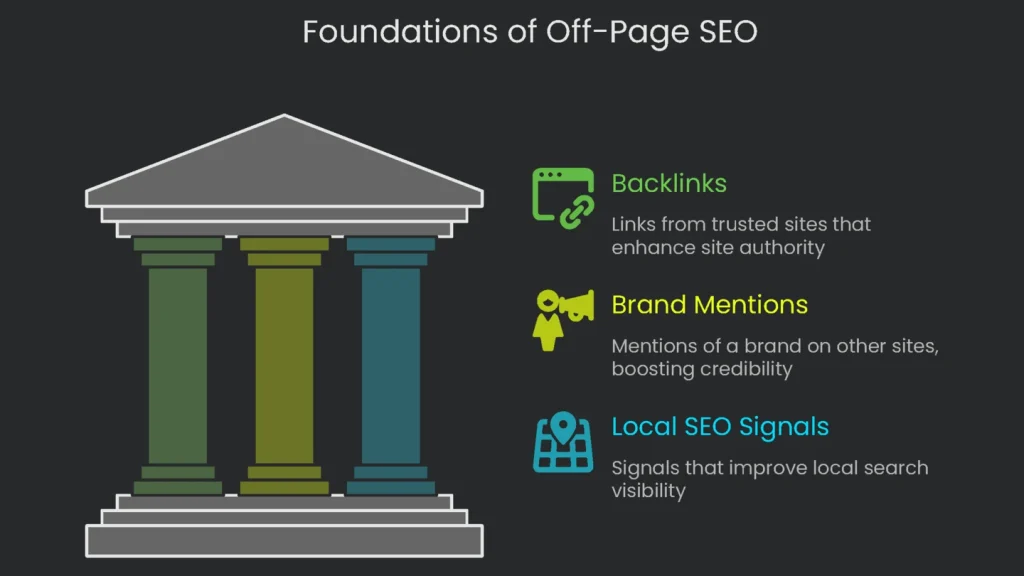
A site’s off-page reputation relies on a few specific signals from the outside world. Let’s break them down.
Backlinks from Trusted Sites
Think of a backlink like a referral from a trustworthy friend. It’s a link on someone else’s site that leads to your site and is the number one off-page ranking factor. When search engines evaluate a site’s authority, they count how many of these backlinks it has and how good they are. The best backlinks come from sites known to be trustworthy and topically relevant. You can earn them by publishing great content that others want to share, or you can be more strategic. For example, guest posts on respected blogs and outreach to share your research are common ways to “build” those links without crossing ethical lines.
Brand Mentions
A brand mention happens when someone talks about your brand on their site, even if they don’t link back to you. Today’s search engines are clever enough to spot these shout-outs and tie them back to your name anyway. Consequently, every mention acts like a tiny award badge, boosting your brand’s credibility and saying, “We matter in this field!”
Local SEO Signals
If you run a shop that serves a certain neighborhood, local SEO signals are your off-page secret weapons. They help search engines show your business when someone types “best tacos near me.” Here are the must-haves:
- Google Business Profile (GBP): Setting this up correctly is how you land on the local map. Double-check your address, phone, and store hours. Every detail counts!
- Citations: When directories and local blogs repeat your business Name, Address, and Phone (NAP), it builds neighborhood trust. If the info doesn’t match everywhere, it creates confusion, so keep it synced.
- Customer Reviews: When happy patrons drop five stars on Google or Yelp, it’s like getting a seal of approval that both shoppers and engines can see. Consequently, managing ratings is part of the local SEO game and your shop’s reputation.
How the Three Pillars Work Together
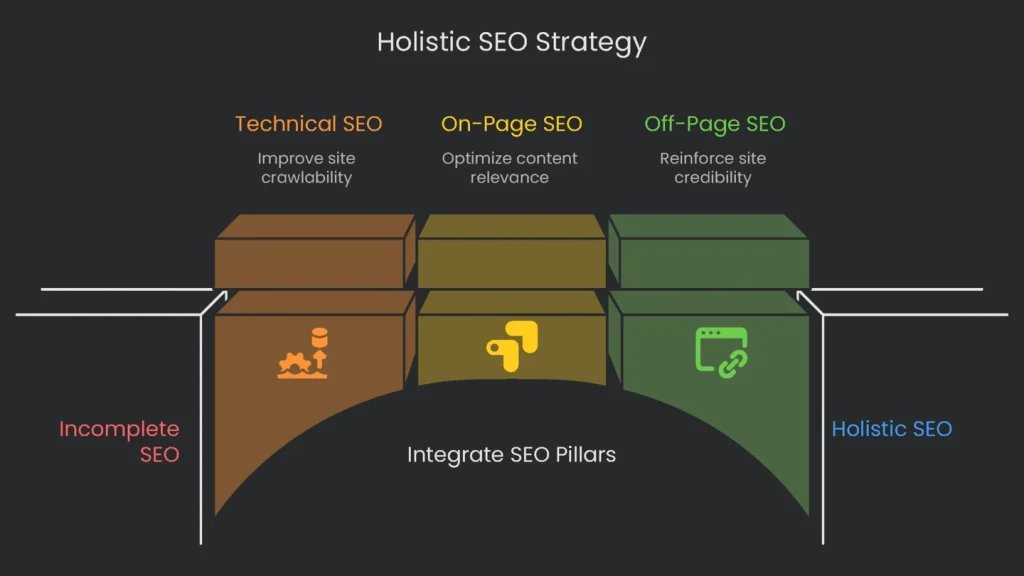
You can’t just polish one part of the system and call it done. An awesome SEO plan treats all three pillars—Technical, On-Page, and Off-Page—like best buddies joined at the hip. When they work as one, they make your site easy to find, easy to trust, and really popular at the same time.
Step 1: Technical SEO Clears the Path
Think of Technical SEO as the sturdy highway that carries your road trip. It fixes broken bridges and ensures search engines can find, crawl, and index the articles you wrote. No highway = your awesome stuff gets stuck at the toll booth and never makes it onto the map.
Step 2: On-Page SEO Fuels Demand
When you build the perfect page—fast, easy to read, and loaded with useful details—other sites can’t wait to tell the world. That’s how you score real, trustworthy links and mentions: the currency of Off-Page SEO. Conversely, a thin or messy page rarely earns a ride on other folks’ links.
Step 3: Off-Page SEO Reinforces Trust
Each quality backlink and social signal is like a compliment from a trusted neighbor. These external nods circle back and reinforce the credibility of your on-site content. Consequently, search engines recognize your site’s E-E-A-T and understand that your material is both right and reliable.
Pillars at a Glance
The table below lays out how the three pillars come together to build a site that both search engines and visitors love.
| Pillar | Analogy | Primary Goal | Key Elements |
| Technical SEO | The Foundation | Access & Speed: Make sure search engines can easily crawl, index, and render your pages quickly. | Core Web Vitals, Mobile-Friendly, Sitemap & robots.txt, Canonical Tags, HTTPS, Clear Site Structure |
| On-Page SEO | The Content & Design | Relevance & Clarity: Show users and crawlers what your pages really cover and how they solve problems. | Keyword Research, E-E-A-T Content, Title Tags, Header Tags, Internal Links, Clean URLs, Alt Tags |
| Off-Page SEO | The Reputation & Authority | Credibility & Trust: Strengthen authority by getting recognized and endorsed by respected sites. | Quality Backlinks, Relevant Brand Mentions, Local Profiles, Customer Reviews, Accurate Citations |
Build a Site With Real Strength
Climbing toward the top of search results isn’t about quick, sneaky hacks. It’s about crafting a lasting online asset. Just like a skyscraper, your web presence needs the right support. Therefore, start with a solid base, then add each floor with care.
If you sink a ton of cash into first-class content (Pillar 2) and fancy link-building campaigns (Pillar 3) while your website’s guts barely hold together (Pillar 1), you’re taking a gamble. Missed crawl paths, sluggish load times, or shaky security quietly eat away at everything else. Consequently, that’s money disappearing—doors closing—without you noticing. Stabilizing your technical foundation first is like putting a vault door on the cash you invest in marketing.
Get the pros who eat, breathe, and drink these foundational details, and your team can relax. When your tech is dialed in, every cent on content and every networking hour on links suddenly becomes a real, lasting treasure. That’s how sustainable visibility is built. Finally, want the complete picture of how these pillars keep your website in good, profitable shape? Check a deep dive.
Implementation steps
- Scan across Technical, Content, and Authority pillars for unaddressed needs.
- Solidify the backend (crawl timing, indexing promise, speed promise, and 100% security promise).
- Draw coherent topic clusters and touch up content to align with changing goals.
- Raise brand stature with targeted digital PR, alliances, and one-of-a-kind tools.
- Scan blossoms, dusk KPIs, and shift the budget toward stories moving the needle
Frequently Asked Questions
What are the three pillars?
Content, Technology, and Authority (number of links and mentions).
Which pillar matters most?
They all need to work together; if one is off, the others can’t reach full strength.
How do I invest wisely?
First, keep the tech running smoothly. Next, create quality, in-depth content. Finally, earn links from other trusted sites in the same topic area.
How do I measure progress?
Check coverage of the site, keyword rankings, the volume of links, and conversions, looking at each pillar.
Do pillars change over time?
You may focus on different things, but the core rules stay the same.