
You no longer need to dread the thought of a migration tanking your traffic. We map redirects, guard content duplicates, and launch with QA to seamless visibility transfer.
Ready for a fresh website? Thrilling, but it comes with a dark plot twist: a single misstep during the migration can wipe out traffic like it never existed. One day the stats look normal, and the next, the screen is blank. This guide unpacks horror-movie style migration fails and hands you a step-by-step action plan for locking down rankings and dollars. Curious how experts turn a migration panic moment into a walk in the park? Let’s dive in.
What is Website Migration?
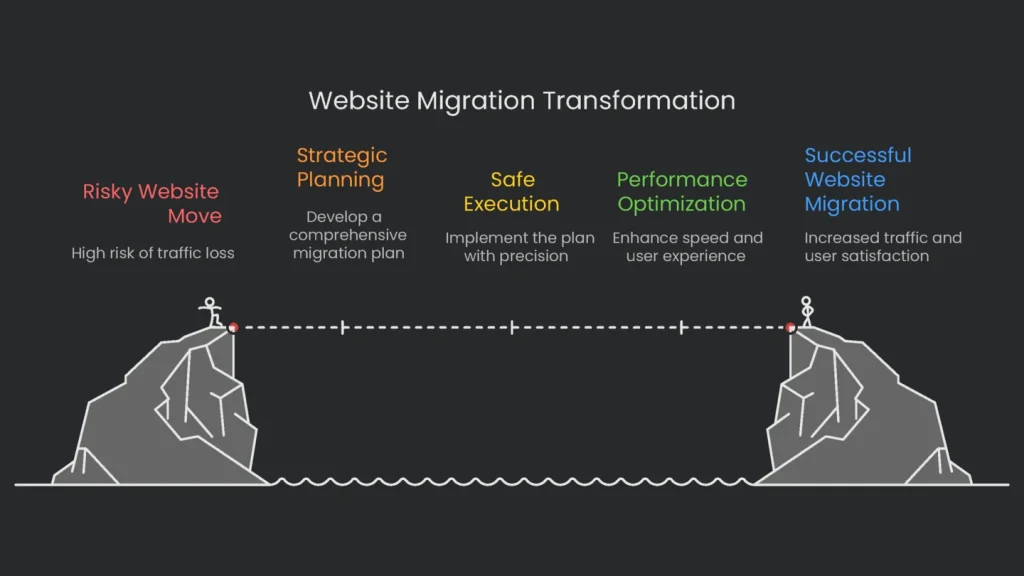
Relocating your entire site, whether you’re swapping the colors, changing the URL, or switching software, is a perfect moment for a glow-up. This is your chance to speed it up and pamper your visitors with easier menus and faster pages. However, as writers warn, that glow-up is also the sketchiest time for your website. One tiny wrong setting, and the traffic you’ve sweated for years disappears like a soap opera character’s sudden leave of absence.
At Technicalseoservice, we make the risk of moving a website a winning play. Think of our service as the safety net for your brand’s entire online footprint. We stick to a tested game plan that shields your current success and then launches you even higher. In short, just lifting a site somewhere else doesn’t cut it anymore—our job is to choreograph the entire move so your internet future stays locked down.
The Big Deal About Website Moves
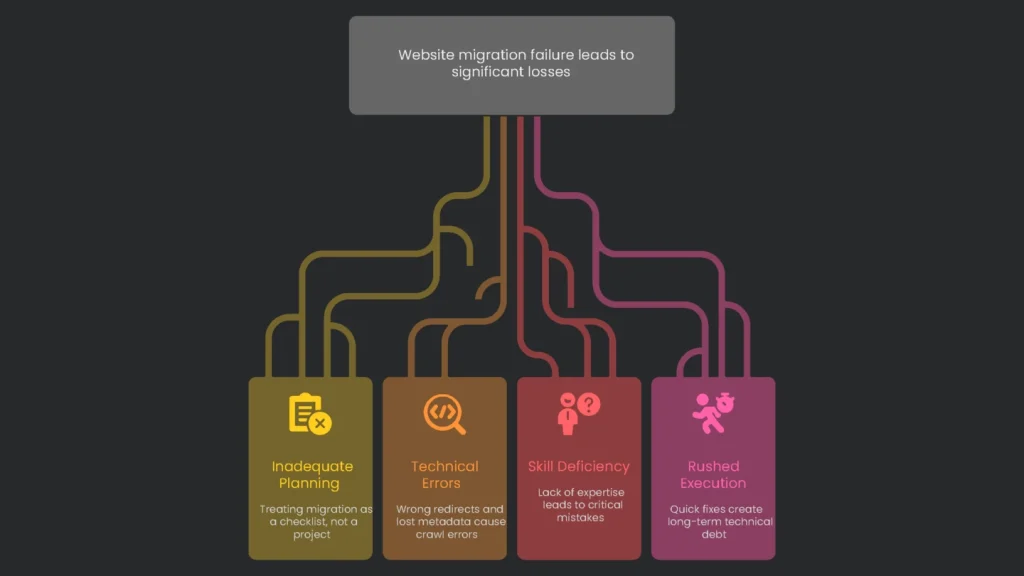
Backing the site up is easy; moving it safely is a different planet. Therefore, this isn’t a ticket you can slide to an intern for practice. The game requires skilled hands, where a single misplaced step can trigger traffic to plummet, rankings to tank, and revenue to vanish. Consequently, execution demands professionals who catch danger at the doorway.
Where Website Migrations Go Wrong
Let’s bring the real numbers to the table. A senior study from Gartner shows a shocking 83% of all migration projects flop, either missing budget, timeline, or both. When a client gives the website move 20 resources and 15 hours, that commitment risks exploding the minute the real job lifts off. This isn’t a coincidence. The industry sees launches burn teams that fail to recognize that simply moving the database is nowhere near the finish line.
When we focus on search traffic alone, the outlook darkens. A botched migration can wipe out 80% or more of a site’s organic visits—no exaggeration. As a result, the trouble compounds fast:
- An e-commerce site, after a migration that missed the mark, lost 80% of its traffic overnight. Consequently, its biggest source of new customers shut like a locked door.
- Another brand saw its ranking keywords shrink from 2,800 to 140. The reason? 94% of its old pages were lazily redirected to the homepage—a small mistake that can kill a site.
In 2023, one report stated that pages which bounced back required an average of 229 days to return to peak traffic. However, 42% of the sites studied failed to regain their previous traffic. A later report stretched the timeline further, showing an average recovery of 523 days, with 17% of sites still limping after nearly three years.
These stories aren’t happenstance. Instead, they unfold from a broken process—wrong redirects, lost metadata, and persistent crawl errors. In short, the migration was treated like a checklist instead of the high-stakes, detail-driven project it really is.
The Hidden Costs of a Failed Migration
Dropping traffic is hardly the worst part of a stumble. That single glitch can spin into a growing mess that bowls over everything else. Consequently, it starts in the code and ends in the cash register.
- Immediate Sales Plummet: A flat migration hits orders first. With organic traffic in freefall, you lose visitors, then leads, then purchases. Therefore, your sales funnel turns into a wall.
- Investment in the New Design is Wasted: Remember the budget earmarked for that gleaming new site? It vanishes before your eyes. McKinsey predicts the next three years will see over $100 billion lost on moments like this. First you buy the new site; then you fight to rescue the same site.
- Ad Costs Soar: When organic traffic vanishes, you must fill the hole fast, and that isn’t free. As a result, your team boosts paid ads so the site doesn’t disappear from Google. Suddenly, acquisition is twice as expensive and the return drops into the basement.
- Brand Damage: Imagine your best customer clicks a link your team sent, only to land on “404 Not Found.” Their excitement turns to annoyance. Broken pages and misfiring links chip away at trust and can stain your brand permanently.
- Sticky Technical Problems: A fast fix can build a digital house of cards. Those rough patches become “technical debt” that balloons in price every time it’s ignored, luring developers away from growth projects.
The takeaway couldn’t be sharper: a single technical SEO screw-up can trigger a chain reaction across marketing, sales, and support. Therefore, stopping that chain reaction is exactly why we’re here.
Our 4-Phase Migration Process
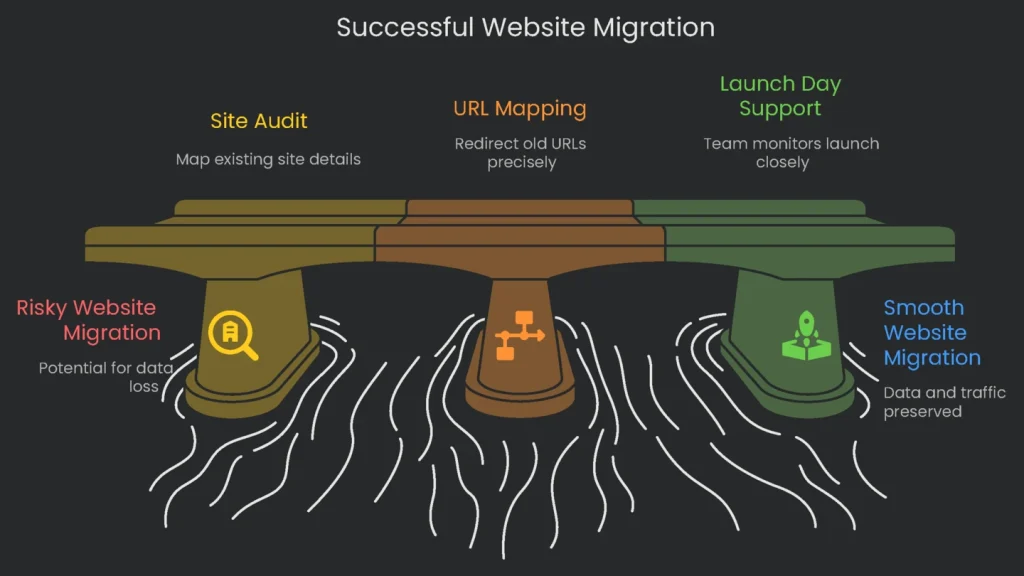
Worried about being the next horror story? You can’t rely on luck, and you shouldn’t settle for avoiding only the obvious traps. Instead, the answer is a method crafted to kill problems at every point. We call it the 4-Phase Migration Method. Next, here’s how it works—phase by phase.
Site Audit and Benchmarking
Long before a single image moves, we draft a detailed map of the existing site. Only when we know what every page, link, image, and setting looks like can we safeguard what matters most. Consequently, nothing critical gets left behind.
- Complete Site Crawl: We fire up state-of-the-art crawlers to comb through every nook of your site—not only your homepage and menu links, but also hidden crown jewels like images, PDFs, and spreadsheets that often get overlooked yet pump in solid traffic.
- Data-Driven Valuation: We go deep with every URL. By charting data from Google Analytics, Google Search Console, and referring URL trackers, we rank pages by sessions, revenue, search position, and who links to you. Therefore, only the most valuable pages walk the red carpet.
- Health Check-Up: We run tests straight from our ultimate migration checklist to kill broken links, wipe duplicate content, and snip unnecessary redirects. Why haul baggage to your shiny new domain? Consequently, we clean the closet before the movers arrive.
- Performance Snapshot: We capture rankings for top keywords, traffic in real time, impulse buying rates, and overall page scores. This is the baseline scoreboard we’ll frame right next to your desk after go-live.
URL Mapping and Redirects
This is the danger zone and the heart of migration. Every scrap of search juice built on old links sleeps inside those slugs. Our mission is to teleport it, pixel for pixel, without spillage. Therefore, precision matters.
- Redirect Map First: We start with one spreadsheet that shows every old URL and its new home. We demand a one-to-one swap. Not a single old article gets dumped on the homepage. That sloppy hack tosses years of work into the bin and tells Google nothing is worth remembering.
- Banking Link Strength: We apply a 301 (permanent) redirect every time. That’s the green light that says, “Yes, we mean it—hand the ranking juice over.” Meanwhile, 302 (temporary) stays in the toolbox, unused, because it misleads robots and leaves ranking stuck on the old page.
- Trial on Private Staging: We test in a private copy of the new site that only we can see. We run the map and chase down broken links, redirect loops, or stubs that might raise alarms. Additionally, we lock search engines out, so we don’t feed them duplicate content before launch.
To appreciate how much time and trouble this saves, review the table comparing land mines we see often and the parachutes we guarantee so you avoid the crash. For example, here’s what we prevent:
| Typical Mistake (The Danger) | Our Promise (The Safety Net) |
| Redirects that break send folks to 404s, wasting both visitors and link juice. | A mapped 301 redirect list that we prep, test on a staging server, and check again the minute the site goes live. |
Search engines can be locked out by noindex tags or a wonky robots.txt. | We review both files under a microscope before and after launch and also scan Google Search Console to confirm. |
| Title tags, meta descriptions, and schema can vanish if the CMS gets angry. | We back up all key on-page data so, if anything goes missing, we restore, republish, and, if possible, level up even further. |
| Internal links that fall apart deliver users to dead ends and muddy SEO strength. | A crawling tool runs the entire site, flushing out dead links and forcing fixes before the launch cheers even start. |
| Performance nosedives and mysterious errors creep in and linger undetected. | We monitor rankings, traffic, and crawl reports for weeks to spot glitches before the team can blink. |
Launch Day Support
On launch day, the command center fires on all cylinders. SEO analysts, developers, and project managers work side by side like a flight crew. Consequently, every page gets clearance so the new site lifts off without a hitch.
- Team-Up Launch: Your devs and our team go online together when traffic is light—usually late night or a weekend—so regular customers never notice.
- Launch Checklist—Right Now: As soon as the site is live, this to-do list jumps into action:
- Search Engine Access: We double-check that nothing on the new site is accidentally blocking search engines from viewing any pages.
- Redirect Test: We click through your biggest pages to verify that our 301s lead visitors exactly where they should.
- Site Map to Google: We send the freshest XML sitemap to Google Search Console and, if the web address changed, we file the “Change of Address” notice.
- Critical 404 Scan: Our first automated crawl watches for server errors or 404s that could trip search engines and visitors.
- Analytics Check: We confirm that every tracking and analytics code loads on every page so you collect visitor data without a blank moment.
Post-Launch Monitoring
The job doesn’t end when the shiny new site goes live. This phase is when the launch gets stress-tested. Meanwhile, Google needs time to learn the new address book. Our team stays on call to keep the transition smooth.
- Watchful Eyes: For weeks, we keep the show running. Google Search Console stays on the big screen to catch crawl errors. Keyword trackers watch for surprise drops. Live traffic is compared to the Phase 1 baselines we set earlier.
- Zoom, Zoom, Fix: Vigilance means spotting problems before they sweat. If redirect chains appear or the new server slows a single page, we jump in, hit Fix-It, and sprint to a solution.
- Results, in Real Time: Milestones appear on your screen, showing new and old sites side by side. We talk facts in plain English and let data tell the story from fresh launch to stable, surging superstar.
Why Partner with This Crew?
Our plan is dialed, sure, but the scoreboard is our ten-year run on the hard frontier of digital mountains. Moreover, we match that plan with senior talent who’ve scaled the steepest slopes—one confident move at a time—so the toughest challenges become the smoothest wins.
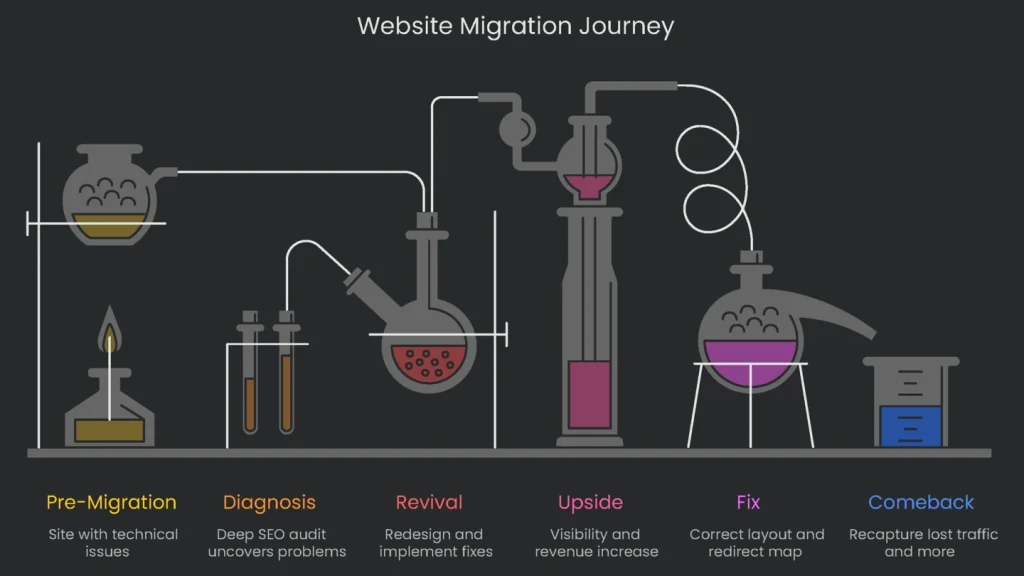
- The Diagnosis: Our first step was to fire up a deep-dive SEO machine: we mapped their current site architecture and compared it against what the new platform built. Countless redirects were missing, critical category pages had vanished, and JavaScript rendering issues kept the bots in the dark. The results were clear: the situation was 100% salvageable—if we acted fast.
- The Revival: Within a week, we redesigned a failsafe migration plan, added tight QA checkpoints, logged every planned 301 and 302, and implemented Smart Redirect Atom—our self-correcting redirect API.
- The Upside: Launch day was stress-free. Within 30 days, visibility climbed past pre-crisis levels, and the bounce rate dropped by 15% because we also optimized key page loads. Finally, the retailer saw a 30% revenue surge thanks to rank consolidations across high-margin products.
- Our Fix: Our audit lit up urgent red flags. The previous agency had scrambled the layout, misused Google’s toolset, and left dozens of technical issues untouched. We tore it down to the studs and rolled out our four-phase procedure. By diving into server logs, we traced Google’s crooked crawl path and built a fresh redirect map to straighten everything out.
- The Comeback: Six months later, the rebound blew everyone away. We recaptured all lost traffic and more, sending numbers sky-high. Total organic traffic climbed by 370%, and 3,000 fresh keywords hit page one. Consequently, a faultless migration proved to be more than a safety net—it became the lead.
A Partnership You Can Trust
We get that giving someone access to your digital front door is a big leap of faith. Therefore, we repay that faith with straight talk, thorough game plans, and laser focus on your bottom line.
“Handing over our multi-million-page site move to Technicalseoservice was the smartest move we ever made. They beat our high hopes and ran the whole operation from A to Z—right on schedule and within budget. Their updates were crystal clear, the reports were spot on, and the crew knew our quirky CMS inside and out. They kept our nerves in check during what could have been a mad scramble. The shift took place without a single bump, and we’ve seen a skyward spike in our traffic since we went live.”
Move Your Site with Us.
Website migrations lay out a clear choice: risk losing everything you’ve got, or turn the leap into a launching pad to fly higher than before. Winning the jump isn’t chance; it’s the roadmap you obey. Therefore, trying a messy migration on your own—or with the same folks who build ads—is a high-stakes roll with your most valuable asset.
Picking Technicalseoservice guarantees you a safe landing. Our fail-proof playbook, built on moving the trickiest sites on the web, locks in your success before you start. Keep the ranks, traffic, and sales you’ve hustled for. Finally, let us turn the move into the edge your competitors envy.
Protect Your SEO Gains. Let’s Map Out Your Move Together.
Implementation steps
- List every existing URL and set up one-to-one 301 redirects that point to the new set.
- Create a staging site to build and test everything, checking that the content, meta tags, schema, and page rendering all match.
- Go live using 301 redirects, updated sitemap files, and assigned Google Analytics tags.
- Dive into logs and GSC—spot a 404, slam on the brakes, and fix it—no wait zone allowed.
- Size up traffic and rankings; tinker till the line flattens or climbs
Frequently Asked Questions
What are the biggest dangers to my site?
Losing visitors when redirects break or when pages look the same to search engines.
How do you keep that from happening?
We list all the important URLs, set up redirects, run tests in a staging environment, and double-check everything when the new site goes live.
When should the SEO team get involved?
Right from the first planning meeting and all the way through the launch and the weeks afterward.
How do you measure whether the move worked?
We look at how many pages are still indexed and ranked, at page speed across devices, and at whether revenue is back to normal.
Do you help after the switch?
Absolutely—we keep watching the site, fix any holes, and keep making improvements.