
Technical SEO optimizes the discoverability and speed of a webpage, while onpage SEO makes the webpages more compelling and interesting. Understand how structure, speed, and semantics work in tandem to accomplish synergistic ranking goals.
Introduction: Two Parts of One Machine
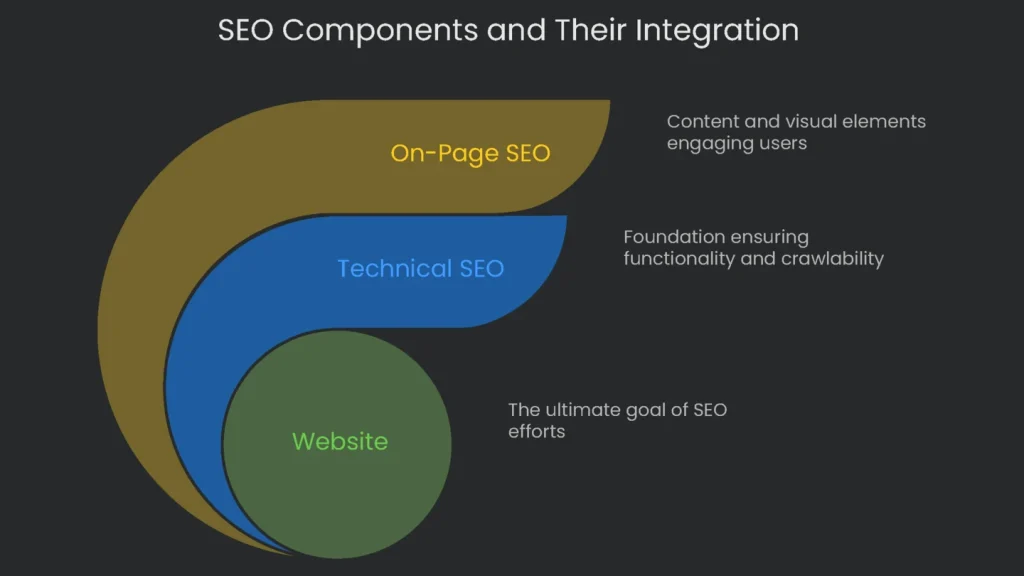
When you jump into SEO, all the vocabulary and checklists can spin your head. Among the most talked-about, yet tangled, terms you’ll meet are Technical SEO and On-Page SEO. Business owners hear the buzz and know they should invest in SEO. However, they don’t always see the difference between these two must-do areas. They look separate at first glance, yet they constantly talk behind the scenes. In short, picture your website as a custom sports car zipping toward the next street race.
- On-Page SEO is the roaring engine, the shimmer of the freshly waxed paint, and the leather seats shaped just for the driver. Basically, it’s everything you notice right away. The headlines, images, page titles, and the snacks of useful info you serve up work together to make a visitor’s ride smooth and memorable.
- Technical SEO is the hidden architecture inside the car. It’s the steel frame that handles twisty turns, the tuned gearbox that shifts on time, and the electronic circuit that sets the stereo’s perfect volume. Most of it is tucked behind panels. However, without it the turbo won’t boost, the brakes won’t bite, and the ride won’t impress anyone.
Many comparisons exist, but this car imagery tends to stick. Picture a fast-looking sports car with a shiny body made of spaghetti—cool to watch but useless on the racetrack. Now picture that same car with a roaring engine but a frame made of muffin tins—still not finishing the race. Therefore, your website needs both polish and strength.
You can pack a site with killer writing, images, and headlines. However, if the code is buggy and the layout is wobbly, nobody can even take the first test drive. Flip it, and a picture-perfect code base can keep it rock-solid. Yet if the copy and visuals limp, the audience won’t stay to watch the finish.
When you keep this chrome-and-chassis picture in mind, fixing sites gets simpler. Traffic flies in and then straight back to the search-results racetrack? Consequently, your engine—your copy and videos—probably doesn’t grip the audience. Nailed the copy and visitors never even make it through the front door? Then the code frame and the plugin carburetor aren’t sending the clicks anywhere useful. This guide will break down both the visual and engine bits, show how to tinker with each, and help you finish the search engine sprint.
What Is Technical SEO?
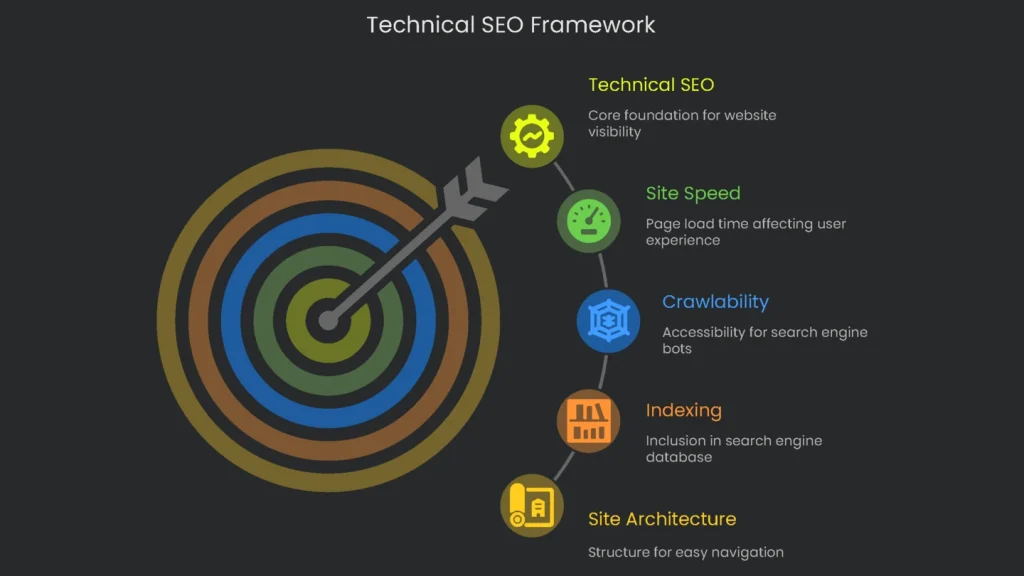
Technical SEO is about fine-tuning the gear in your website’s engine room so search engines can sail through without hitting rocks. Think of your site as a subway. Technical SEO lays the rails, signal lights, and tunnels so crawling bots can ride through, scan every car, and remember all the stops. It isn’t about writing great stories or snapping perfect photos; it’s the scaffolding holding the masterpiece upright. As a result, when everything’s installed right, a crawler is like a train conductor who can zoom through and issue tickets right away.
The Purpose of Technical SEO
The main job of Technical SEO is to handcraft a smooth route from the digital street to your site. The goal is to kick tiny glitches—broken links, slow loads, and hidden pathways—out of the way so search bots can stroll in and memorize your goodies. When your site’s bones are tidy, other SEO elements, like award-winning blog posts and images, stand a real chance of being recognized. For a little more digging, you can explore this additional article. Therefore, think of your plan like a treasure map: you can’t go to the X before grabbing the shovel and lantern.
In the same way, a website needs a sturdy technical framework before you hang the beautiful art. If the walls aren’t up, the best content disappears into the digital ether. If crawlers can’t peek in, there’s no ranking and no glory for your hard work.
Main Parts of Technical SEO
Tech SEO is the blueprint for that sturdy framework. Therefore, let’s quickly highlight the bricks you can’t skip.
Speed of the Site
- What it is: In plain language, site speed is the number of seconds it takes for a page to show up in a browser.
- Why it’s important: One extra second feels tiny, but it has mighty muscle. Nearly half of visitors will turn on their heels if a page lingers for more than three seconds. Consequently, that bounce signal can push a site down the search queue. For crawlers, speed is a budget concern. They have limited time for each site. If a page loads like molasses, they skip extra rooms and miss them for the index.
Crawlability
- What It Is: Crawlability means search engine bots, often called “spiders,” can reach every important page by hopping from one link to another.
- Why It Matters: Before your site can shine on Google, it needs to be crawled. If bots can’t crawl, they’ll skip indexing, and you won’t show up in results at all. Smart tech tweaks help, too.
XML sitemaps and a robots.txt file act like a map and a guide that keep spiders on track.
Indexing
- What It Is: After a bot crawls, it studies the page and saves it in a vast database known as the index.
Indexing is basically dropping your web page into Google’s gigantic library.
- Why It Matters: Pages that aren’t indexed can’t be found in search results. To ensure all useful pages get added, use tech SEO to clear any traps that block indexing.
An example is the “noindex” tag, which keeps a page out of the library.
Site Architecture
- What it is: Think of site architecture as a digital blueprint—how pages fit together and talk to one another. Good design keeps key pages only a few clicks from the homepage.
- Why it matters: A tidy layout makes it easy for people and robots to spot your most important content. For search engines, the architecture works like a simple treasure map. As a result, it helps juice flow to the pages you want to spotlight and allows a full walkthrough without dead ends.
Security (HTTPS)
- What it is: Security means using Hypertext Transfer Protocol Secure, or HTTPS. The extra “S” locks data exchanged between a visitor’s browser and your site.
- Why it matters: Google treats website security as a ranking factor. Because search engines guide people to safe, trustworthy places, a site on plain HTTP gets the cold shoulder. Moreover, a site without security can lose visitor trust, letting HTTPS-enabled competitors steal the spotlight.
On-Page SEO: Filling the Structure with Gold
Technical SEO lays faultless plumbing, ceiling tiles, and hidden wires. Then On-Page SEO walks in and polishes every light switch. It’s the daily spit-and-polish where marketers fine-tune a page so it bursts with clarity for people and machines. While the code works in the background, the visible stuff—words, diagrams, and well-behaved HTML tags—must be both eye candy and brain food.
In the library where Technical SEO built the perfect building, On-Page SEO is the scribe hovering over the manuscript. It shapes the cover and imagery to match the beating heart of the book, wraps titles around bait you can’t refuse, and lays subtitles so your eyes glide. Therefore, the chapter becomes a lion of clarity. You tuck a bibliography in the right HTML tag and the librarian—the search engine—whistles, “Correct section.” Voilà, your page is not just safe; it sparkles.
The Main Goal of On-Page SEO
The top goal of On-Page SEO is to prove your page is the best-fit answer for a particular search. When someone types a question into Google, On-Page SEO helps the engine see your page deserves the spotlight. Higher rankings lead to more visitors. Consequently, you get more chances to guide them toward becoming paying customers. It’s about making your site show up, shine, and help the people you want to reach.
Key Elements of On-Page SEO
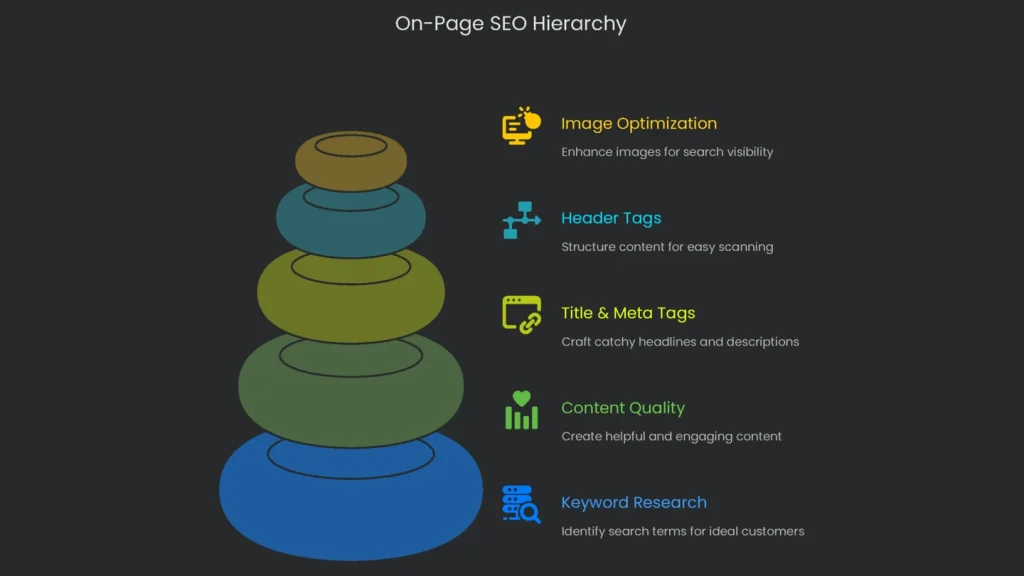
To reach that goal, On-Page SEO fine-tunes a few must-have parts on every page.
Keyword Research
- What it is: Keyword research means figuring out the exact words and phrases your ideal customers type when they want info or products like yours.
- Why it matters: Keywords are the starting signal for your On-Page work. By picking the right ones, you can write content that matches the searcher’s purpose.
Search intent draws in best-fit visitors who truly want what you sell.
Content Quality
- What it is: Create content that is helpful, trustworthy, and enjoyable to read, made for people and not just robots.
Top-notch content is one-of-a-kind, keeps visitors interested, and genuinely helps them out.
- Why it matters: Google’s systems are good at spotting content people like. Short, boring, or low-value pieces won’t rank today, no matter how fancy the other details are.
Title Tags & Meta Descriptions
- What they are: The title tag is the bold headline, and the meta description is the crisp sneak peek in search results.
- Why they matter: Treat them like free ads on Google. A clear, catchy title and description can win more clicks. As a result, Google reads that engagement as usefulness, which can lift rankings.
Header Tags (H1, H2)
- What they are: Header tags are road signs that break content into scannable sections. The H1 is the main title, and H2s are the chapter titles.
- Why they matter: Headers slice text into bite-size pieces for quick scanning. For search engines, they outline the page and highlight main topics so bots can understand it fast.
Image Optimization
- What it is: Dress images for the web with sensible file names, helpful alt text, and compressed file sizes.
- Why it matters: Good alt text teaches search engines what a picture shows, enabling visibility in image results. It also helps people using screen readers. Moreover, huge images slow pages and make users impatient.
How They Overlap and Work Together
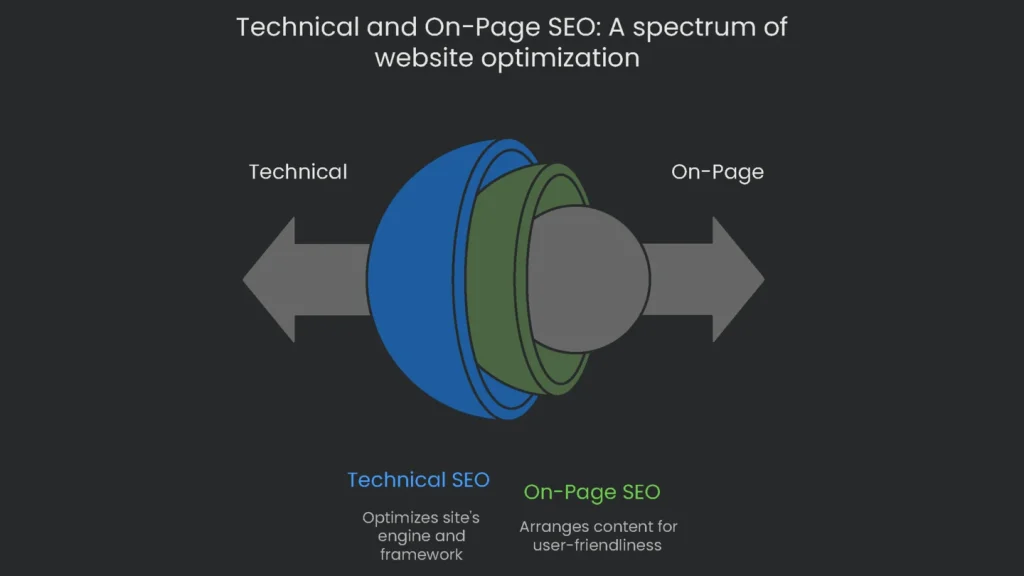
Beginners sometimes think Technical and On-Page SEO live in separate boxes. They don’t. These two are close friends who finish each other’s sentences. If your site is a library with locked doors, no one—people or bots—can enter your brilliant articles. That’s Technical SEO. If your neon “Open” sign is burned out, readers can’t read your amazing content correctly. That’s On-Page SEO. Both lead to the same news: the page doesn’t rank.
Way back when, lines between the two were fuzzy. “On-Page” tactics often included small tech fixes because builders and crawlers were on stubborn dial-up. As sites grew and engines became faster, web architects patched core code behind the walls. That shift let creators push flashier ribbons of content. Consequently, Technical SEO earned a shiny business card of its own. Both still meet daily at the same coffee-stained table, debating how to make visitors happiest. Next, let’s wind through a few overlap zones.
Internal Linking
- The Tech Piece: A top-notch internal-linking plan is the framework of your online city. It weaves an invisible web that helps Google’s bots wander every street and alley to find must-see spots.
- The Content Piece: Inside a blog post, an internal link is a helpful signpost. The highlighted phrase we click is the “anchor text.”
Anchor text briefly outfits both humans and robots for arriving at the right page.
- The Bridge: Technical SEO builds the roads and neighborhoods (site structure). On-Page SEO plants the colorful street signs (contextual internal links) to show exactly where to turn next. As a result, roads get people to the area, and signs guide them to the right house.
Mobile-Friendliness
- The Tech Piece: The heart of a mobile-friendly design is “responsive design.” This lets your site squash and stretch to look good on every device. Because Google now checks the mobile version first, a responsive site is essential.
A responsive site is the only ticket in.
- The On-Page Side: This covers what someone actually sees on a phone. After the page resizes, is the content still easy to use? Can a person read the font without zooming and tap a button without hitting the wrong link?
- The Connection: Technical SEO builds the responsive framework. Meanwhile, On-Page SEO arranges the furniture so it feels good to use on a phone.
Page Speed & Content
- The Technical Side: This includes infrastructure improvements like optimizing the server, shrinking file sizes, and instructing the browser to cache elements for repeat visits.
- The On-Page Side: The items a user sees also affect load time. For example, a giant, uncompressed photo can slow the site and make the server work harder. When loading stalls, users bounce, which sends a loud negative signal.
- The Connection: Technical SEO tunes the engine. On-Page SEO determines how heavy the cargo is. When a page is fast, users linger, and well-arranged content lands like an appealing message.
SEO Face-Off: Tech vs. Content
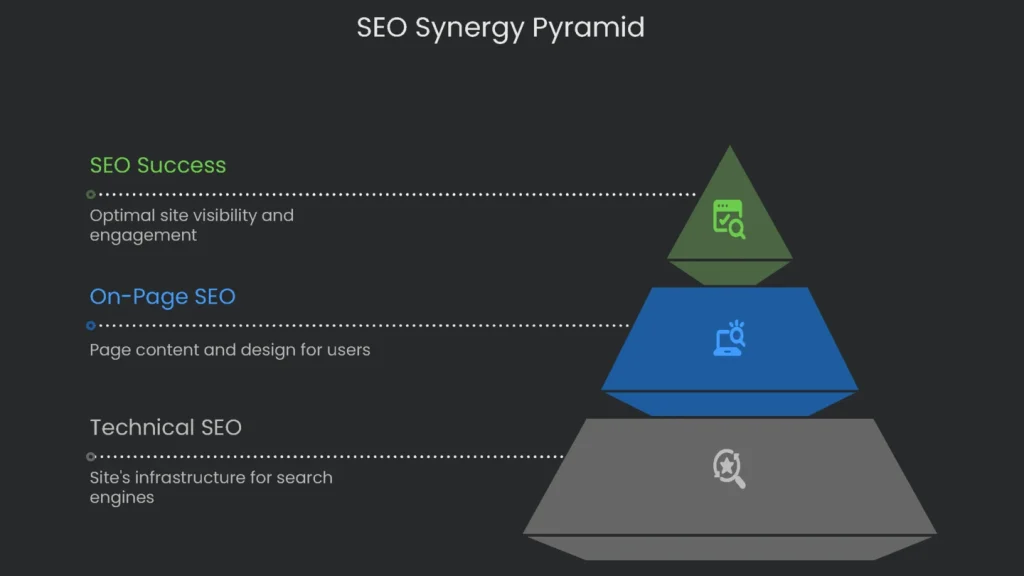
Here’s a quick peek at how Technical SEO and On-Page SEO stack up. Therefore, you can see at a glance which part to tighten up.
| Aspect | Tech SEO (The Infrastructure) | On-Page SEO (The Page Itself) |
| Main Focus | The site’s scaffolding: servers, code, and infrastructure. It’s info you can’t see but that can break the site. | The terms and designs on each page: headers, images, and how users see your message. |
| Main Job | Help search engines crawl, index, and pocket your site. It’s like making the site work for crawlers first. | Show people and bots why your page matters to them. Human and machine both must find it valuable. |
| Analogy | A car’s frame and the parts no one sees. A home’s slab, ductwork, and wires. | A car’s control console and under-hood parts. A home’s paint, couch, and wall hangings. |
| Key Parts | Crawlability, Indexing, Sitemaps, Internal Links, Security (HTTPS), Mobile Grip (responsive design). | Keywords, Meaningful Text, Page Titles, Meta Snippets, Headings, Image Alt Text. |
Wrap-Up: Build the Best Site
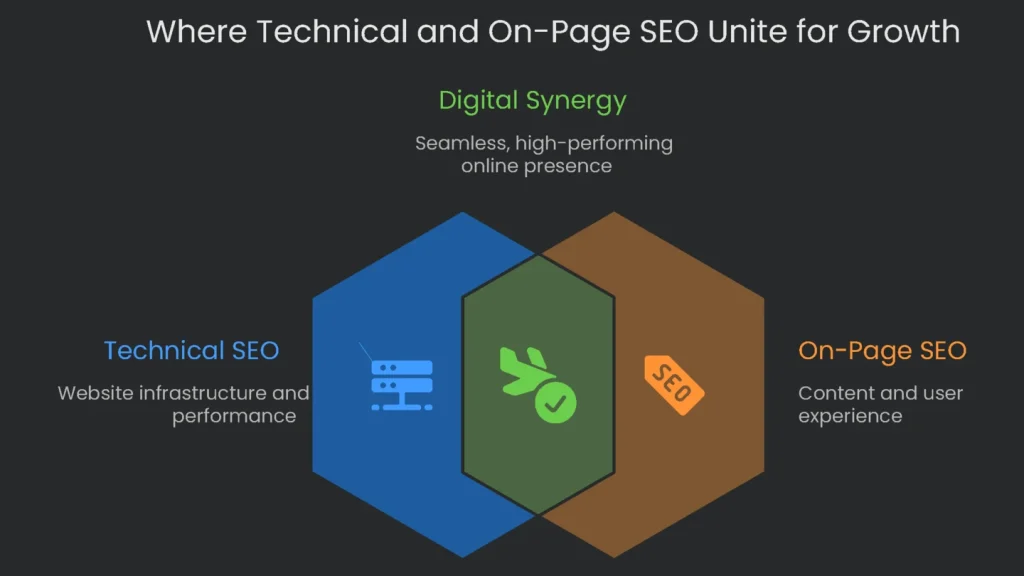
Understanding how Technical and On-Page SEO differ lets you plan an effective blueprint. Each one tweaks a separate section of your site, yet they fit together like a lock and key. Think of Technical SEO as the hidden machinery of a theatre and On-Page SEO as the actors and set pieces. The machinery must work or the show can’t start. Once the curtains go up, performance quality decides how long the audience stays.
An SEO playbook isn’t a “pick one” menu. The best technical rig magnifies even an OK keyword strategy, letting every blog or product page shine more brightly. Meanwhile, the software backbone provides the launchpad all content deserves, pulling in human visitors who make the sale. Keeping that hardware and software running well isn’t a lunch-break add-on. Therefore, specialists should polish every wire and line of code to make the site a smooth ride for search giants. When pros take the technical baton, you can pour energy into building memorable content, products, and experiences. Together, you build a digital jet instead of a bicycle.
If you want a deeper dive, we’ve put together a checklist on link one and the SEO for e-commerce guide on link two. Finally, you can watch the YouTube walkthrough for Shopify and start with the beginner’s guide on link three.
Implementation steps
- Start with tech—crawl-ability, speed, and site structure—before anything else.
- Map the target keywords to high-intent pages; then tun forma tles, headings, and copy till it sings.
- Loop-related pages tighter, guide users, and raise relevance scores.
- Attract scores of quality links to star pages and info centers.
- Jointly review: covered pages, rankings, CTR, and true user actions.
Frequently Asked Questions
What’s the role division?
Tech SEO serves crawl speed; on-page makes the content stick and shines for the searcher.
Where do I start?
Nail the page speed bombs, then multiply high-quality content and killer UX.
Do the two talk?
They do—solid architecture and smart linking supercharge on-page gold.
Who does what?
SEOs lead, devs tune, and writers polish; keeping them apart only decelerates the project.
How do I juggle them?
Craft joint targets and roadmaps where sprints stretch across tech and storytelling work.